
Lee Ufan
Interview with Lee Ufan
by Henri-François Debailleux
Where do you think your painting stands in relation to this second half of the twentieth Century?
For a long time, the question asked by painting was, "What does one paint?" After that, modern painting asked, "What are the elements that constitute painting?" Lucio Fontana proposed a new space with his slits, Yves Klein with the monochrome surface, Barnett Newman with "division." These are all fascinating approaches. But the internal elements in those oeuvres are so powerful that it is difficult to establish their correspondence to the outside world. For them it is enough to be painting itself. For me, the fact that painting has a pre-established character as the intermediary between idea and reality is very important. I have, therefore, tried to re-establish the imaginary dimension and the correspondence, to recapture gesture, the dimension of the body and reality.
The first thing that strikes someone looking at your work is the importance of the notion of emptiness. What meaning does this have for you?
Emptiness is indeed, the central issue in my work. Modern man is afraid of emptiness and refuses to acknowledge it. This is because emptiness, the void, corresponds to what man has not filled, to what he has not done. I myself am very sceptical about the fact that we attribute value only to what man has done. That said, it would be wrong to think that I like only emptiness. What interests me more precisely is a certain kind of emptiness; emptiness placed in relation to fullness. For me, the void is the space that is created by interference or interpenetration between what is painted and what is not painted, between what is done and what is not done. It is the space that is created in encounter, in reciprocity. Taken in this sense, emptiness is neither totally my own production, nor objective emptiness. And it is not about something mystical in this notion of space. In relation to the Buddhist void, which is too idealistic, the emptiness I am talking about is a phenomenological situation. It is the place where man is in relation to what transcends him. It is also the place where one can talk about the value of art's being.
What is the value you attach to the rather austere and rigorous motif that you work through from one canvas to the next, like a set of variations?
I want to be connected to as much of the world as I can, but through an intervention that itself is minimal but intense. I am looking for an absolute relation between my active participation and the passivity of the world. Consequently, I refuse all forms of expression based on the multiplication and expansion of self- consciousness. I therefore try to limit myself and be restrained so as to be receptive to the outside. That is why my painting can seem austere. Indeed, this attitude is not unrelated to my Buddhist and Confucian background. Above all, though, it is linked to my will to find the origin of the work in a place beyond my own self. My paintings have thus become compositions based on simple variation, by paring down the elements of painting. The repetition comes from my desire to make each touch more meticulous, firmer, more right. And it is this difference between touches that creates the variation.
HOW do you use chance to set this up?
Modernism, which sought for the oneness of reason and the world, excluded the outside world, and denied chance, which is the other face of the outside world. Now, for me, expression is non-identity. What matters to me is not the expression of the self, but entering into relation with the outside world via the intermediary of my body. And the work is the place of meeting with the outside world. Still with chance, of course; in fact, it's even the unpredictability of this encounter that I find so exciting.
Does the positioning of these motifs serve to create figures, insofar as one can link them together visually, or do they evoke an imaginary path?
My painting does not exactly offer a figure, or, indeed, a composition. I think of it as a medium term. It
expresses a relation to space and creates a relation to the viewer. I also want there to be a poetic dialogue with them, for the work to stimulate their imagination, for it to enable them to reach out beyond the canvas and open up to the infinite world outside.
What connection do you make between this notion of the imaginary and the principle of the maze?
It's a very important subject. Seen from outside, the maze does not exist. When you look at it from close up, there is a rule, like in the game of go. And there, you can understand the layout from the geometrical elements. If my works suggest a maze, it is because they are in relation to the unknown. In spite of their simple, clear appearance, they are connected to the indefinite, to the outside. When you enter into them, multiple paths open up and it is the dialogue with these paths that inspires the imagination. But this imaginary space is not given in advance, that is to say, my works are not mazes of the imaginary inner space. It is impossible to sense the maze in a work that is generated automatically. True, it may create infinite space, but it is a space where everything is defined in advance, and therefore with no room for the imaginary.
Do you consider this motif as a form of writing?
I think that my work is closer to writing than to painting, in the sense that there is no representation. For me, writing is not a simple recording of knowledge but, rather, the poetic expression of a certain relation. It is a ceremony and an exercise so that the moment when my body meets the canvas is an elevation. Seen from this angle, writing is the work of differentiation and reflection.
Do you give it a kind of brand-image status?
The repetition of this motif can effectively be seen as a brand image. But that is not my aim. My approach is thus fundamentally different from that of certain artists who multiply their self-expression and systematically deploy it in the form of a logo or pattern on any support. What they want is to "colonise" the world by inscribing their pre-established motif. In their expression there is only the repetition of the same. Difference is excluded. It is, in other words, a way of excluding and denying the other. Whereas the question for me is how to get back to the outside and to welcome the other into expression. The work is simply a structure for allowing the imagination to establish a poetic correspondence with the exterior. It is therefore important to distinguish the different origins of the motif and the different meanings of repetition.
You work with the notions of point, line, surface and plane. How do you relate to Kandinsky, for example?
The elements that elicit a simple reaction are elementary forms such as the square, the circle and the triangle, or indeed the rectangular and vertical plane, which are closer to the conceptual. Surface, line and point appeared in my painting because of restriction, the limitation of expression, whereas Kandinsky found them by analysing the elements of painting.
What is the importance of gesture for you?
The gesture of painting (or making a sculpture) involves my body, and it is impossible to replace it with someone else's. For a long time, the body was seen as a tool for expressing consciousness, a position that Merleau-Ponty roundly refuted. As he very clearly showed, the (my) body does not belong only to (my) consciousness, but is part of the world. And to act on this body that is part of me and part of the world, one must simplify and hold back the expression of the self. That is why gesture can bring in the elements and the external force that do not belong to me. Such a gesture is expressed in a pure and ordered style. And there is a tension because the body belongs to both kingdoms.
Why do you work with non-colour?
The truth is that I would like to have all the colours, but it is impossible to use them all in the work. Also, if I chose a colour then it would immediately express a particularity. That is why I choose the shade of grey: it keeps a certain distance, both from reality and from the conceptual world. It is sufficiently suggestive and implicit. It's the same, too, with the sculpture: I don't want the material, the colour of the metal or stone to serve any specific idea. I want them to be neutral and suggestive.
You work in both painting and sculpture. What do these two practices bring each other?
Painting is made within a pre-established surface, even if it suggests an exterior. Sculpture is made within a relation to time and external space, even if it is the expression of the artist's inner space. In other words, in painting you can evoke the indefinite exterior in a clearly delimited plane surface, and in sculpture you can express the interior within an exteriority. The flatness of painting belongs to the domain of ideas by virtue of its indirect character, whereas sculpture is linked to the immanence of space and matter. Painting is indirect and imaginary; sculpture is direct and reversible. Depending on the vibration I feel between my interior and the exterior, and depending on the vector of this vibration, my work takes shape either as painting or sculpture. I do not want to be totally engaged with the ideal world, nor totally with the real world. Both attract me. That is why I like to work with the complementary relation of painting and sculpture.
Why do you use untreated materials like stone and steel? Does this non-treatment have the same meaning for you in sculpture as the non-painting that you mentioned earlier?
It was often thought that the work of art was something that was made totally by the artist. But this conception of the artwork as the expression of the artist's self was given a good shaking up by Marcel Duchamp's readymade. With the introduction of the object produced automatically by a machine, the myth of personal expression took a real knock. What can you do after the advent of an artwork that is only partly the expression of the artist? What can you do after the work that criticises industrial society? My response to this is to introduce what is not manufactured, working from the principle that seeing, choosing, borrowing or displacing are already part of the act of creation, since for me it is impossible to simply have something that does not suggest any trace of the artist and leave it at that. My raison d'être as an artist lies there, in this problematic that consists in linking doing and non-doing. I try to connect to the outside world by linking the natural (stone) and consciousness (man) with a simple sheet of iron. I use stone and sheet iron as they come, which is how they contain the outside world. That is why it is important to have that borrowed, or pre-established or suggested aspect. Because it is extracted by man from stone, metal is therefore half-abstract. It is therefore suited to playing an intermediary role.
With hindsight, what view do you take of Monoha, the Japanese movement that you led, and that had a number of things in common with Minimal Art, Arte Povera, Support-Surface and Anti-Form - all those many movements that flourished in the 1960s and through to the mid-1970s?
It is difficult to establish relations between these movements and Monoha because there wasn't enough information available in Japan at that time. That said, Monoha did play a role in contemporary art and left its mark with its critiques of the limits of productivist thought of industrial society and of its unintended consequences. We were criticised for the dispersion of our style, which was due, precisely, to the introduction of the external. We were also criticised for insufficient formalisation. I do not contest these criticisms. But, after Monoha a lot of attitudes and directions appeared that were interested in the external in matters of expression.
At the time Monoha was not recognised. I myself was rejected for several exhibitions. I therefore decided to make use of all the resources I had: personal exhibitions, writing, symposia, etc. We met every day with young artists who were in the same position as myself. We debated and analysed our ideas and projects. In general, everyone tended to show their work in solo shows, but we did take part collectively in some big exhibitions. My role was to liaise between the members and write in order to make us better known, simply because I was the oldest and enjoyed writing. These texts have in fact became a precious documentary resource for finding out about the meaning of what we did. Later, starting in the 1970s, I also tried to get Monoha known around the world in the course of my frequent travels. From the start Monoha did not exist as a group. Each of the artists involved took a different direction.
You talk about the outside world a great deal. Where do you set the frontier?
Today it is quite common to see artists introducing unadulterated reality into the field of expression. The gallery or museum becomes the framework into which a piece of life is introduced as content. This has nothing in common with what I say about introducing the outside world by borrowing or by suggestion. I can understand the approach that consists in reducing the distance between reality and expression, but I don't think we should destroy the frontier between the two. In fact, I don't think that expression has a particular or prestigious status. I simply believe that the relation between expression and reality, or between expression and idea, involves a solution of continuity. Because when expression is identical to reality, there is no room for the imagination. When you are face to face with a work, in a dialogue with it, you need to be able to move towards another dimension. If there isn't this possibility of transferring dimensions, then what is the point of expression?
What is your approach to space?
Physical space isn't very important to me. What interests me is space as a place. The place is a space opened by the presence of something, as a result of my participation. It is not only space, nor only the object. The place is a space-time. It is close to the concept of space-between (ma in Japanese), which is created in the relation with the person perceiving it. In Japan, you can see empty rooms decorated with a small flower. Here a living, luminous space is opened up by the presence
of this little flower.
And to time?
The fact of being born in Asia influences my perception of time. People in the West look for eternity in art and architecture. Whereas in a region where it rains a lot and everything changes very quickly, we see eternity in change. The cyclical aspect of life is manifested there. In a way, disappearance is felt more strongly than appearance. In my work, too, the temporality of being is stronger than its longevity. Death or disappearance is not the end. If man's autonomy is linked to the notion of space, time can be understood as the world's automatism.
Your desire to convey a sense of the ephemeral therefore implies the omnipotence of space and time. HOW do you fight that?
That reminds me of Heidegger, when he said that the artist is engaged in a struggle between the world and the earth. There is no device for fighting or resisting the power of space and time. I find a few columns in the desert or a few fragments of paint on the walls of a cave tremendously inspiring. What I see there is the tension between the human will to endure and the brute force of nature. The work is between these two opposing forces: causing to disappear and wanting to endure. Ruins and fragments are moving because they illustrate this situation very clearly. A complete work in which the human will is triumphant does not move me at all. When I make a brush mark or when I move a stone, I try to give them a provisional, transitory character. I try to give the Impression that they are on the frontier between being and nothingness, and that they could disappear at any time, and that at the same time they are strong enough to withstand. It is not my will that my works should endure against all odds. Someone once asked me what I would do if the canvas yellowed and if the touch faded. There can't be an answer, because everything will disappear eventually. What the work of art can do is in effect show and give a sense of the existence of these two worlds, that of appearance and, at the same time, that of disappearance, which is the very condition of all existence.
When I make a brush mark on the canvas, I hold my breath, I concentrate and I pray that my hand, the brush and the canvas will be in harmony. My artistic work is accompanied by prayer and reflection, as is the case with sporting performance, a scientific experiment or life in a monastery. This is because creation is an encounter, a call and an answer. I can never be proud of what I've done. In each canvas, even if the results look the same, I have felt something different and am doing something different. If seeking is the active expression of my will to go somewhere, work is the exercise of the passivity that is receptive to what comes.
What is your relation to Taoism?
There's no direct relation. I would simply say that I am influenced by the Taoist attitude that consists in understanding the world in its relativity and in its reciprocity. There are some words of Chuang-tzu's that I like a lot: "From close-to, it's me, from afar it's the other."
In: Cat. Lee Ufan, Painting, Sculptures, 52nd International Art Exhibition – La Biennale di Venezia, Palazzo Palumbo Fossati, Venice, Fondazione Mudima, Milan 2007
The interview is quite deep, I can not fully understand what is he trying to hive people, but I had a lot of feelings came up after what Lucio Fontana said, "modern painting asked, What are the elements that constitute painting?" But I done know how to express it clearly yet, I think this is what I learned in foundation. By lots of approaches lead to my final piece. In the 16th question, he answered what I think every contemporary artist should reflect, the world changes so fast everything changes so fast nowadays. Fast fashion is the easiest and the most obvious example of what Lee Ufan trying to say.
"It's not trying to achieve perfection. It's actually trying to achieve imperfection." When look at 18th century Chinese pottery, its almost too perfect. Japan tries to get perfection also, but Japan tries to create a humanist to it. Korea; However, is situated right between these two. That is exactly what Lee Ufan like, reflect life in it. Life is changeable, life is imperfect, which allow to become open, free, to oneself more. By the uneven color, shape, I think Lee Ufan is creating the flaws with the rest of the piece. How it combined together, how it composed into one piece.
https://www.schwarzwaelder.at/items/uploads/module_pdf/1488383349_WljdHJ7EulG.pdf
An Interview with Lee Ufan
David Hockney

When David Hockney began his career, figurative painting was considered old hat and even retrogressive. The assumption in advanced circles was that abstraction was wholly superior, raising large, lofty questions about the essence of painting instead of getting bogged down in the picayune details of postwar life. What possible wisdom could be gleaned from a painting that depicts a palm tree, for instance, or the glistening turquoise of a backyard swimming pool?
Hockney, who is often described as Britain’s most celebrated living artist, has painted those precise subjects and is well aware of the suspicions of triviality his work can arouse. Sitting in his studio in the Hollywood Hills section of Los Angeles, he recalls an amusing snub. He was visiting a gallery in New York, when he bumped into critic Clement Greenberg, abstract art’s most vociferous defender. “He was with his eight-year-old daughter,” Hockney remembers, “and he told me that I was her favourite artist. I don’t know if that was a put-down. I suspect it was.” He laughed softly, then adds in his gravelly, Yorkshire-inflected voice, “I thought I was a peripheral artist, really.”
Nowadays, in an age when the choice between abstraction and figuration is dismissed as a false dichotomy, and when younger artists imbue their work with once-taboo narrative and autobiography, Hockney is an artist of unassailable relevance. One suspects we will see as much when a full-dress retrospective of his work opens at the Metropolitan Museum of Art in New York in November. An agile, inquisitive draughtsman inclined to careful observation, he has always culled his subjects from his immediate surroundings. His art acquaints us with his parents, his friends and boyfriends, the rooms he has lived in, the landscapes he knows and loves, and his dachshunds, Boodgie and Stanley. He is probably best-known for his double portraits from the Sixties and his scenes of American leisure, the sunbathers and swimming pools that can have a strange stillness about them, capturing the eternal sunshine of the California mind with an incisiveness that perhaps only an expatriate (or Joan Didion) could muster.
In the 1960s, Hockey was easy to recognise, a boyish figure with an apple-round face, a mop of blond hair and his trademark owlish glasses. Nowadays, at 80, he has grey hair, and he wears a hearing aid in each ear. “Every time I lie down, I have to take them out because they fall out otherwise,” he says. He is able to carry on a conversation amid the quietude of his studio but feels it is futile to head out with friends. “If you are going out in the evening,” he says in a slightly rueful tone, “you are going out to listen, and I am not very good at listening.”
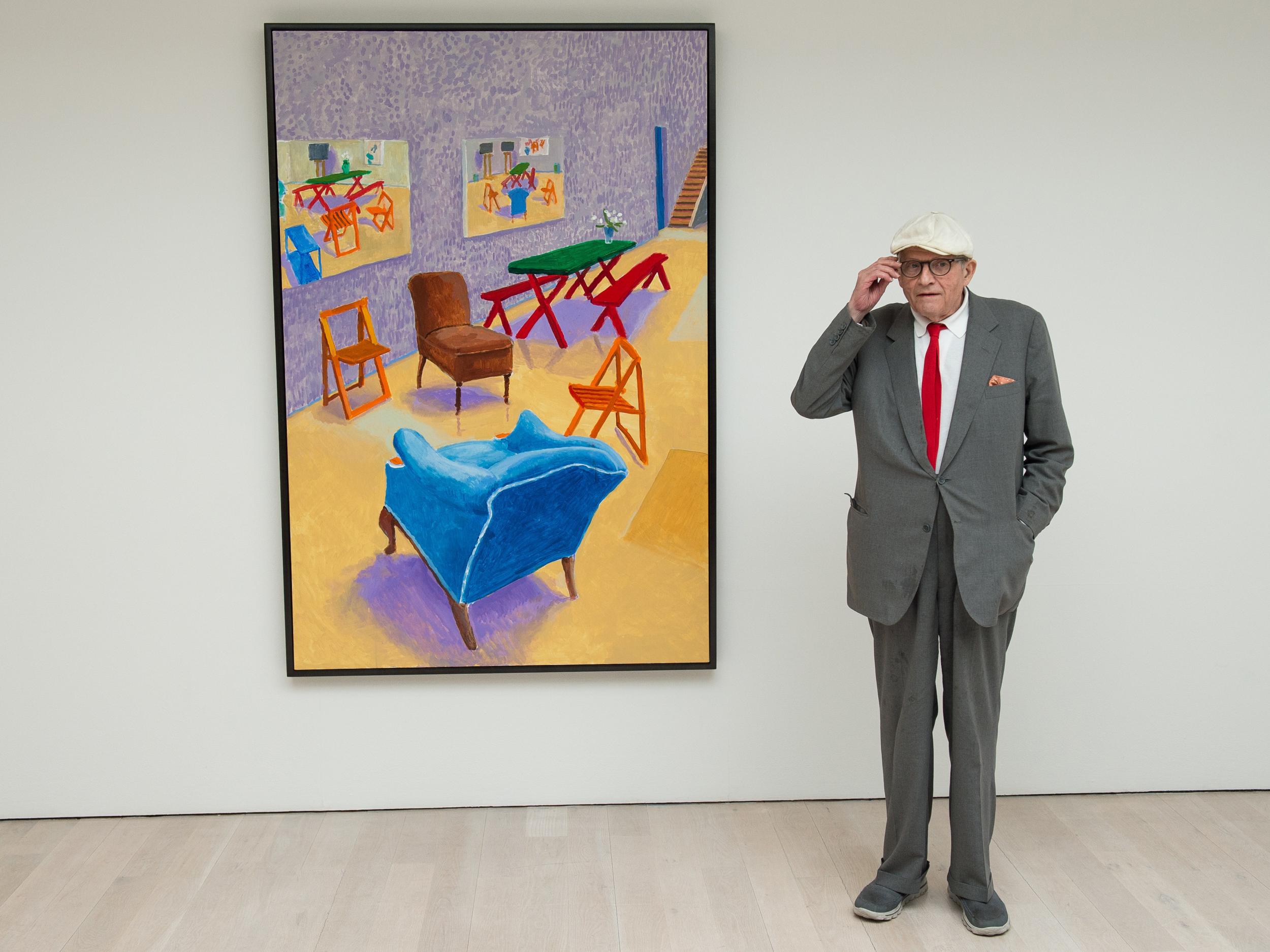
Hockney is still a dapper, vigorous presence. His conversation is wide-ranging and larded with literary references, and his manner is so genial and confiding that at first you do not notice how stubborn he can be. He delights in espousing contrary opinions, some of which come at you with the force of aesthetic revelation, while others seem perverse and largely indefensible.
In the latter category, you can probably include his regular denunciations of the anti-smoking movement. He smokes a pack a day and blithely discounts the hazards of cigarettes and cigars. “Churchill smoked 10 cigars a day for 70 years,” he tells me with apparent glee. “Well, nowadays, they tell you that cigars are the kiss of death. Churchill didn’t think so.”
Unlike other exiles, who typically bemoan chaos in their homelands, Hockney is still a British citizen and speaks about the Queen with unalloyed admiration. He is completing a 20ft-high stained-glass window for Westminster Abbey in her honour. He shows me his design for the window: a 10ft-tall inkjet printout inscribed with a lush floral scene. He composed it on his iPad. Its subject, he says, is the English hawthorne blossom, but to my eye, it appeared semiabstract and called to mind Matisse’s windows for his chapel in Venice.
Hockney, it might seem, is a direct heir of Matisse’s fauvism, pushing colour contrasts to trippy and hedonistic extremes. Yet when Matisse comes up, he is curiously silent. Perhaps the story of Matisse’s influence is so abundantly evident that he feels that there is nothing to say about it. Or perhaps he just feels more temperamentally aligned with Picasso, whom he does like to talk about and whose Cubism speaks to his obsession with the mechanics of vision. In 2001, Hockney published an important book, Secret Knowledge: Rediscovering the Lost Techniques of the Old Masters, which argues that advances in realism in Western art could not have been possible without the sly use of mirrors, camera obscuras and other optical devices.
These days, in his newer paintings, Hockney is exploring the concept of “reverse perspective”, which poses yet another challenge to the accepted story of Western painting. Before my visit to his studio, he emailed me a recent discovery of his: a 105-page essay by Pavel Florensky, a now-forgotten Russian mathematician who died in 1937, a victim of Stalin’s goons. Florensky was also a gifted art historian, and his 1920 essay, Reverse Perspective, is a dazzling piece of revisionist criticism conceived in defence of 14th- and 15th-century Russian icons. He argues that correct perspective is overrated. The absence of perspective in Russian icons – as well as in Egyptian art and among the Chinese – was not a blunder but an inspired choice.
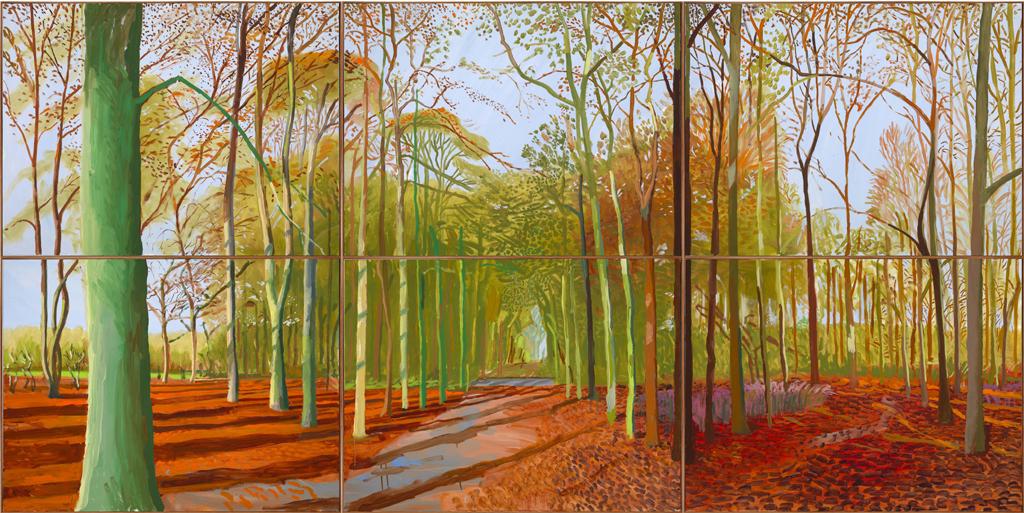
Elaborating on that theme, Hockney says: “In Japanese art, they never use shadows.” He takes out a book of woodblock prints by Utagawa Hiroshige and flipped to a page that showed a small wooden bridge arching across a powder-blue body of water. “There is no reflection,” he says. “Even with a bridge, there is never a reflection in the water.”
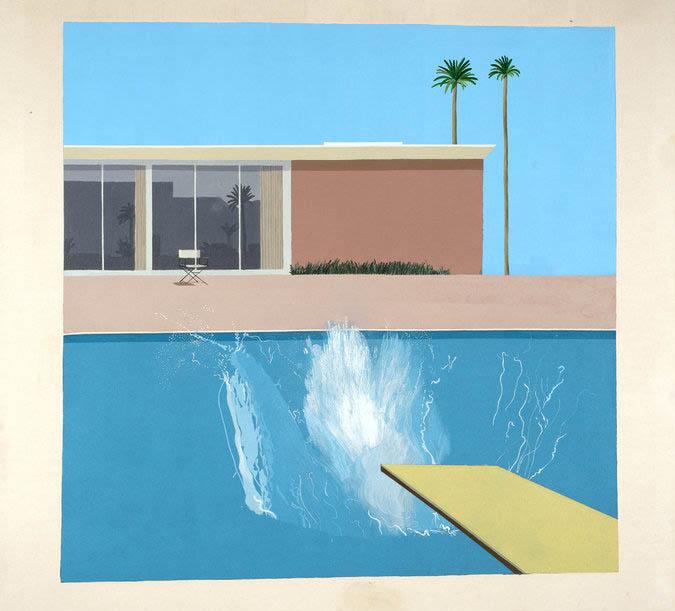
I really adore David Hockney' s attitude with trying new attempts and different styles all the time, and that is what I am perusing for as well. Also his paintings guided me to think about the relationship between time and space, for instance, his swimming collection, "A Bigger Splash", "Peter Getting Out of Nick's Pool", and "Portrait of an Artist,Pool with two figures" stopping the dynamic second in this picture, capturing the moment of diving. He used vivid colours and transparency to show the city's scenery and his leisure time. Bringing a meaningful record for the humanistic observation of the times. David Hockney always highlights his "ing" memory in his life.
He said there is no formula to create his pieces, and I think that is what makes him like that. So that he can add his own feeling into this painting, make this painting "warm" with his own personal temperature. And he also said normally children like his painting, which he considered it as a good sign. To me the reason that children like his paintings is because children tend to like pure colours, they are favoured in the high hue and value like red, yellow, orange, and green. The more colourful the paintings is the better to children.
David Hockney – ‘I Like to Live in the Now’ | TateShots
James Rosenquist
James Rosenquist, one of the key American Pop Artists, has been making and showing his paintings for over 25 years. His early ’60s work, like that of Andy Warhol and Roy Lichtenstein, provides a seductive but critical mirror image of the mass media.
Rosenquist’s Pop period came to a close in 1965 with his F-111, a multi-panel room sized painting dominated by an image of an American bomber. Among his more recent projects are Star Thief, 1980, a mural originally commissioned for the Miami Airport, and Flowers Fish and Females for the Four Seasons which now hangs in the restaurant. The artist is presently working on a series of paintings entitled, Welcome to the Water Planet.
Mary Anne Staniszewski I’d like to talk about your early work as well as the recent projects. Let’s start with now and work our way back. What are you working on?
James Rosenquist: I realised that a number of things happened to me and occurred to me. Like they do to everybody. And these experiences were saved or accumulated and then I put them together in some peculiar way and that peculiar thing becomes a painting idea. Sometimes I think about a major question or a major theme and then I think about imagery in regards to that. So, currently one of the themes is called Welcome to the Water Planet. We live on a water planet. And it was an idea of people putting to bed, or putting under their pillow, the fear of the atomic holocaust, a nuclear war. So the idea, the division of the ideas in this series of paintings, came from early settlers in America hiding in lakes or streams while a forest fire went by. The imagery that occurred to me seemed like a water nymph hiding in a water lily while some star nova or nuclear thing went by far away. And also the idea, welcome to the water planet, was a “welcome.” It was sort of against chauvinism.
MS Did you do any of the water planet paintings yet?
JR I did. One is going to Atlanta. I’m working on those now.
MS Where is it going to in Atlanta?
JR In this new building in Atlanta.
MS It’s one of these corporate buildings?
JR Yeah.
MS Is most of your work being bought by corporations right now?
JR No. No. Private people and museums. Museums seem to have a want list—and a budget. But they never match … .
MS Do you work in the same method as you did in ’61?
JR Well there’s another attitude before you get there, and that is to dream up the image in one’s mind and to want to do it. A person’s never satisfied with an image.
MS So you see it in your mind’s eye first.
JR You see it in your mind’s eye. It’s perfection. To try to match that up with reality is extremely disconcerting and troublesome at best.
MS Have you ever achieved this in your work?
JR I don’t think so, no. I wouldn’t think so. But to do that, I always thought that a person should really practice how to paint and how to draw and should really get skilled trying to do the final trick, the final vision, the real vision. The other method is more like a collage attitude of life. You walk around in a certain state of mind and you stumble on it and there it is, like love at first sight.
MS You see yourself working in the former method?
JR Well, I work both ways. To be creative is to be accepting, but it’s also to be harsh on one’s self. You just don’t paint colors for the silliness of it all. And maybe it has to be different, some new pictorial invention. There’s a meaning and an idea and many layers of vision in the same picture. And so at first glimpse, it looks like that (snaps fingers) and then you look a little further and go, “Oh there’s something there too.” There’s more there. Any great masterpiece painting is like that. There’s subliminal values and colors there that hide things and seep out slowly.

James Rosenquist, Zone, 1960–61, oil on canvas, 95 × 95½ inches. Courtesy of Leo Castelli.
MS Because your work is composed of fragments, it always has that abstract quality. But to get back to the point you were making about coming upon things, stumbling upon things, taking them and collaging them together. Could you talk about the way you first began to put the image fragments together and what led you to do that? I’m going to read to you a part of a 1964 interview which I think is one of your best.
You said that you had some reasons for using commercial images that these people, the critics, probably hadn’t thought about—do you remember this?—You said, “I use anonymous images—it’s true my images have not been hot-blooded images—they’ve been anonymous images of recent history. In 1960 and 1961 I painted the front of a 1950 Ford … . It wasn’t a nostalgic image either. I use images from old magazines—when I say old I mean 1945 to 1955—a time we haven’t started to ferret out as history yet.” What led you to use these older, cool images?
JR Well, I’ll tell you why. It seems like every artist looks for his own—his or her own space. Their own ground-breaking places and it seemed then that the latest rage was French non-objective painting. And as I understand it—French non-object painting—there’s no meaning, except pure color and it’s supposed to be pure color and pure form. Well in the attempts at doing these non-objective paintings—which had vestiges of leftover cubism, or whatever—things would appear, unconsciously. I saw an exhibition at the Howard Wise gallery on West 57th of this old artist whose teacher had been Hans Hoffman. And Hans Hoffman walked into the room. It was a winter day and Morris Kantor and Miles Forest were in the room. Old Hans came in with a “Snoopy hat” on with its earmuffs down and his hearing aid. He said to this man who had been his student, “What’s that there?” And he replied, “It’s winter solstice” or something like that. And Hans says, “looks like Popeye to me. Looks like Popeye sitting in a chair, see, see his head.” And there was Popeye. He had a pumpkin head, a stick body, big feet, hands, and it was supposed to be totally non-objective painting. Only colors. Feeling. And it embarrassed the man and from there onward that was Popeye. You could not eliminate that. So, the point is—my ambition at that time was to get below zero.
I wanted to deal with things in a different way. First of all I used the grisaille palette, black and white. I started on black and white. What I wanted to do was to take these images, anonymous images from advertising, place them in a picture plane, in a certain size and a certain scale—really well-painted fragments—and have the largest fragment the most close-up and the most anonymous because it was magnified so much. It would be like seeing an image, but you wouldn’t quite know what it is. So, people thought they were mysterious. These paintings had a mystery about them. “I know what that is.” But what is that?
Now what happened to me: when I came to New York, I had a scholarship to the Art Students League. My life changed drastically. I was like a young bum. I had no money. I lived really poorly. I walked everywhere. The luxury of being in a car was amazing. At the same time I encountered Beat Generation people. I met Jack Kerouac, I met Allen Ginsburg. I didn’t know him very well. Also part of that—but not the so-called Beat Poets—were Miles Forest, Bob Indiana, Larry Rivers, Dick Bellamy. I think in 1959 Esquire listed Coenties Slip* as the “in” place to live. During the mid-’50s Betty Parsons existed, Sidney Janis, and then there was East 10th Street between Third Avenue and Broadway. The 10th Street Galleries showed Helen Frankenthaler, Grace Hartigan—second generation Abstract Expressionists. The new unusual place was Coenties Slip. Bob Indiana, Jack Youngerman, Delphine Seyrig, Ellsworth Kelly were down there. There was also Randy Mullerman, Agnes Martin, and Jesse Wilkinson (I think it’s important to mention the people who didn’t get famous) and the Beat people were around too. Ivan Karp wasn’t a Beat at all. Roy Lichtenstein wasn’t either. The WWII veterans, Ellsworth Kelly, Roy Lichtenstein, Sal Scarpitta, and Leo Castelli. They had a different attitude. The Beat Generation people are ten years younger and hadn’t been through a big conflict … . Suddenly they were stunned by the atomic bomb. The Beats were allegedly reacting to the nihilism of a holocaust. The Beats, their life was sort of nomadic. And my life was nomadic—simple things and simple pleasures, a marijuana joint, a peanut-butter sandwich—extremely simple. I remember seeing three guys walking along, and one guy picking up a cigarette without breaking his stride—smoking someone else’s cigarette butt. And the funny part was that you couldn’t tell if these people were really from wealthy families or really poor ones. They were all acting this way.
So finally after being in New York a long time, two girls took me to the race track in a car. A car! Fantastic, a seat in a car. I appreciated the thing in a completely different way. Also my values had changed. I really lost track of what things were. What I mean is in a capitalist country, or not a capitalist, in a kind of country where capitalists advertise in media—I lost track of all that. I wasn’t up on the latest rage. For about a year when I first came to New York I lost it. That put my mind in a whole different situation. I tried to develop some ground, some idea—where people could look at something, yet appreciate it for another kind of value. A different kind of value.
So, I thought the problem now is eliminating images from a non-objective painting and I would use imagery as a guide to show what things will be looked at first, like in a game. Something simple like that. But I’ll use this with the same power that I had painted billboards—the same strength and intensity and exactness used for selling these products, but they won’t be made and they won’t be painted to be sold. We are numbed in this atmosphere as young children and young people. So l decided that I was going to work in this advertising media numbness. It would be something if someone did that now. It still would be viable.
So, I started doing this painting of pieces of imagery and it changed and changed and changed. I painted them over and over and over. And I was experimenting. It was my first painting called Zone. And it wound up just being part of a lady’s face and part of a tomato all in gray. Underneath that painting are many, many images. And I was testing things out. I had a man committing suicide like a later Warhol painting. The man going head first out the window was only about as big as a cat on the scale of the canvas. So I eliminated that. I had a huge shirt front with a big salt shaker sprinkling on the lapel, like sprinkling salt on a dove’s tail. All sorts of surrealistic things, yet the scale was too large for what I thought surrealism was. I never wanted to be pigeon-holed.

James Rosenquist, Vestigial Appendage, 1962, oil on canvas with painted wood, 72½ x 93¼ inches. Courtesy of Leo Castelli.
MS You said you wanted to paint with the power and gusto of advertising. In a certain sense were you trying to beat them at their game?
JR Beat them at the game would mean to use something with the force of death, not beat them at their game, but to use something with that force—then people would be made to look at it differently. You see, I’m not beating them at their game, I’m just using their tools of paint and my talent to change this—to not think of this as advertising. This is a painting.
And I think Warhol did that too, but he just put the image there. He did, however, change it synthetically with silkscreen. But I rarely ever used, I never used a brand name. I think the closest I came to doing something like that was when I painted a big dish of red Campbell’s noodle soup—way before I ever saw that Warhol did a soup can. It was called, In the Red, this big painting with part of female and male images in the big red tomato soup.
MS There have been fragments, like Pepsi Cola, or Coca Cola. Think of your Marilyn Monroe.
JR Yes. I never used the whole word Pepsi Cola.
MS No, it’s always a fragment of things.
JR Fragments of things, because it is too easy then.
MS And then it would be too much like promoting the products … . Did you have Lifemagazines from 1945 lying around, or did you go and find them? I presume you got most of these images from Life. How did you start collecting them? What made you think to do that?
JR I just found some old Life magazines and I was, you see, searching for the look of something. My aesthetic may come from—this may sound strange—but I was always up close to a huge image and it had to be exact. I felt as though I was painting this whale, like a Moby Dick—that feeling. The mystery of the big shape was uncomfortably close and made me want to think about that kind of thing. Also, I experimented with tricks. One of those tricks was when Gene Kornberg or Mr. Strauss or Jake Berman would say, “Here’s some photographs of movie stars, black and white, now you make them look like they’re on a film clip—put some blue in it.”
Then one time I was working up on the Bruckner Expressway on Friday and the boss said, “I’m sending you up there with three men.” I was the boss. I was young. I wasn’t a smart ass but I was in my twenties and they were all in their fifties and sixties. Anyway, as a joke, our job was to paint a huge billboard of a loaf of bread on a bakery. We had to paint it out light gray, to get it ready for Monday. So each man mixed up his gray paint. They all mixed up light gray paint and when they went out to lunch I took about half a cup of red and poured it in one and a half of yellow and poured it into another and a half a cup of green and I mixed it up, and you couldn’t tell. It was gray. Right? As a joke. So, they all went to work and they painted their part of it. The four of us, we each painted a quarter or more. Finished. Everything was cool. We go downstairs and I said, “Gee look at that!” And they turned around and there was this—looked like a Jasper Johns. There was this gray, a yellow gray thing, blue gray thing, there was this red gray thing and they said, “Jeez, what happened?” I said, “Must be the chemicals.” It must be. I didn’t care. It didn’t hurt anything. It didn’t matter. They were afraid they were going to lose their jobs. I never told them. I used to do that constantly. I used to do things, because I was experimenting as a painter there on a big scale.

James Rosenquist, The Prickly Dark, 1987, aquatint, 66⅛ × 66⅝ inches. Courtesy of Richard Feigen & Co.
MS Did you make collages and then use them as a basis for your paintings?
JR No. Here’s what I did. During my billboard experience, I would be handed a paper bag full of material and the images were placed on a sign board. Each image was a different size. It’s like a basis for the beginning of my painting. So then I’d be given a blueprint and they’d say now this rose for Melrose Whiskey is this size—I’d have to adjust the scale. That became very interesting. So in my sketches, I’ll start off with a couple of ideas, a couple of images.
MS Did everything come from magazines?
JR Also from my own photographs. I’d take my own photographs or from magazines, or even a piece of paper—it could be anything. I’d put that together.
MS And the new work?
JR The new thing is a search to find more space in a canvas. Also, I still feel very reactionary about not wanting to look like anyone else’s artwork. Ever since I started painting I never wanted to look like anyone else’s …
MS Your work has been talked about in terms of discarding certain myths regarding the creativity and the power of a painter. I’m talking about the faith in a painter’s brushstroke being the signature of that touch of genius. A de Kooning brushstroke could only be his and therein lies the trace of a kind of macho mystery, a creative power played out on the surface of the canvas with paint. In your work you gave up a little bit of this power to do something new. Were you aware of that?
JR No. I wanted to paint it so well that you wouldn’t see my brushstroke …
MS But you’ve spoken to me about turning your back on this tradition of gestural painting. By painting in this commercial way were you cheapening yourself to do something different? Actually, I’m choosing these words and phrases to provoke you.
JR No, I wasn’t cheapening myself. When I painted, I’ll have to say this now, when I painted commercial art I was painting to the best of my ability. When I painted my paintings it was the same. But when I painted billboard paintings, I wasn’t allowed to compose or think to the best of my ability. When I made my own paintings, I was allowed to do this and I did whatever I damn pleased. It’s a matter of do you dare to do that. The big thing at that time was violating the picture plane by cutting a hole in a canvas. That was really sacred. Fontana did it, … Bob Rauschenberg did a lot of crazy things with the sacred picture plane. I was curious. I did a painting where I mounted little rectangles in back of a canvas and cut the canvas and upholstered it. The painting had a mirror on it and a little box and was called Balcony.
MS Is it still around?
JR Ileana Sonnabend owns it.
MS You’ve said that you wanted the fragments to be corrosive and your titles to be corrosive in the way they interact.
JR Antidote to the acid and vice versa.
MS And the new work, is it corrosive in the same way to you?
JR I think so. The new thing is thinking that flowers are pretty, are colorful, and maybe they are, but maybe they aren’t and also the fragments of ladies faces can be sweet or they can be demons.

James Rosenquist, Welcome to the Water Planet, 1987, aquatint, 75¾ x 60 inches. Courtesy of Richard Feigen & Co.
MS When you’re working, are you thinking about who is going to look at your paintings? Do you see your paintings as images of hetero-male desire? In the ’80s a lot of people might ask those kinds of questions as they look at your work. Are these paintings directed at a traditional notion of male desire? Do you ever think about these questions? Or are you just collecting what appeals to you? Are you thinking about your audience in this way?
JR I’m only thinking about myself. I’m not thinking about my audience … . The important thing is how can you get the energy to work. Why is it worthwhile? That’s the hard part … . When I was painting the billboards they [the bosses] would say: “That arrow shirt color looks dirty or that beer color looks like it has too much hops.” Dirty-shirt tan, Schaeffer beer with too much hops in is, this Chrysler blue they didn’t like, and I’d take them home. I was interested in these connotations that come from life and how do you change these things in non-objective paintings?
MS Are you saying that all things, even non-object painting or a color, are culturally contingent?
JR Let me explain. In my billboard, orange is orange soda and this color is Early Times Whiskey. How can one orange there be these two things? The idea is like how can a glass of water look like a glass of vodka? That kind of idea. Each orange is from the same can, but if I apply it differently it would take on a different meaning. But those painters making non-object painting, they thought they knew what orange was or that green.
… Like Warhol, I was dealing with technology. It still has to be dealt with.
MS Did you think you were being critical of technology and advertising or in F-111, the Vietnam War?
JR Well those have to be taken one at a time. With F-111, sure I was critical. I had heard about the Vietnam War from the photo-journalist Paul Berg of the St. Louis Post Dispatch in 1964 and he told me about things. It was the first war that was live on television. I couldn’t be complacent.
MS 1964 was very early to be against the war.
JR It is! I knew about it in ’64. The magazine to watch today is the Mercenary magazine because you read about who manipulates and who pays for these Third World Wars.
MS Do you read it regularly?
JR Oh I read it a couple of times. You get a Third World account of the conflicts. They put ads in there—“Involved in fire fight in Nam. Ready to fight”—some jerk ready to kill for about $1,500 a week.
MS And advertising, did you think your work was critical of that?
JR Being a child in America you are getting advertised at. It’s like being hit on the head with a ball-pin hammer. You become numb. You’re constantly hit upon. Here’s the way it felt. How does one exist in our culture? The way I felt when I grew up with everything, supermarkets, billboards, radios, commercials, and then at one point in my life I didn’t have any of it. So if you deal with this or stop and imagine or wonder what is really happening to you and then you make a statement about it. Then you say something about it. I wanted to use the tools and technology of advertising to do that. I had been directed to paint things hot and juicy, to sell them. Heh, I thought I could direct my feelings and observe them. I could stop painting advertisements and I could do something about it.
I forgot that I had lived for a time without any media. I would go to a live TV show to keep warm and there I noticed that this TV show being done in New York was being done with a Midwestern flat accent to appeal to a national audience. This was peculiar for me to go to these shows and to think I was back in the Midwest again. And there was another thing. I remember Delphine Seyrig who was married to Jack Youngerman and we were friends. I remember her pushing Duncan down the street in a stroller. She was wearing a beautiful housedress and then one year later she was suddenly in Last Year in Marienbad. She was an international movie star and I thought isn’t that funny. The movie had the same tone as my memory. I remember her last year and, well, she was in Last Year in Marienbad and this movie is about memory and coincidence.
It was a dispassionate view of values. I wasn’t a hot teenager who liked the hot records. I was an old man of 22
I am not a fan of POP ART, even though it seems like everyone in the world know this style, and a huge parts of them like it, I still could not get it. So when I saw "Rainbow" in Ludwig museum, I still did not find it attractive, I was just quite like they way he did it. The window stand properly, and so does the wall, nice and clean, just like every other pop art paintings. He did not used a lot of difficult technique to paint them, the shadow and the gradient colour is not professional at all; However, the water flew out from the window, he made the paint watery, so that you can see the water moving trace. With its back ground, the water stands out. That's why.
"Whenever I got a new studio I made the largest possible painting, and since the ceiling was low, the painting became horizontal. As I changed studios and got larger spaces, I made bigger paintings."He used to say he lives in advertising, they have such visual power and excitement. Painting should be more attractive than advertising, so why can't painting use the same intensity and fun? As the technology developing he still stick with hand-painting.
Dieter Roth
HELEN FREDERICK, WASHINGTON, 12/17/03
Interview with Dr. Dirk Dobke, Director, The Dieter Roth Foundation
How do you remember Dieter at the Rhode Island School of Design?
Dieter was at RISD when I was teaching etching. So we used the back of the zinc plates and they were all pitted and he was very enamored by how they looked like Paul Klee. I really felt like I was a parent to Dieter, and we had this lovely relationship and it was really about practicing art. There was just no other vibration there. One day he came in with those (baggy) pants and he always had stuff in his pockets because he was doing all those food paintings, and he was turning the wheel of the etching press. He had eggs in his pockets and the eggs were running all down his legs.
And he just stood there, frozen, like fish you know, and I didn’t know what to do. I wasn’t going to help. So eventually he left and came back, but it’s just I wish I had a camera to capture, you know, the baggy pants, the T-shirt and this expression like “how could it break?”
Did he carry this food for his paintings? Did he really make people buy things for the pieces or did he just use what was left over from lunch?
I think he had a plan with those eggs to use them for art, because he was working with sour milk etcetera, but my feeling is that it was mostly left around stuff. And this one piece that he gave me, I treasured it for a long time, and then I thought why should one person have this? And it was one of the milk paintings where there were the “Three Tombstones” and he kept putting milk in the straws. I had it, I guess, from ’67 on – the collector Ira Wool would have to tell you – I’m very bad about remembering dates, but maybe in the early eighties, I decided I would send it to him because I kept seeing his name and I trusted him as a collector. So I wrote to him and said I would send it to him and I had it framed, packaged, and it was all glass. There’s no wood, nothing to contain it. So it arrives to Ira totally broken. And was just devastated. So to my embarrassment, without him telling me, he writes to Dieter. Dieter says “that’s fine. Don’t let Helen know. I’ll come and repair it.” So he makes it all new, then Ira writes to me saying, “It’s okay. He restored the piece”.
I have a lot of catching up to do. But you know, as I think about it while your talking- when I think about those tombstones – I think Dieter knew he was going to meet his end by abuse of his body. When he talked about the “Three Tombstones” he talked a lot about decay. But he thought it was personalized. that it really was his own person that he was building those tombstones for, and I’m talking about that piece. And when I think about it, why did he give me that piece? It was a very important piece and I was very honored to receive it. And I knew it was important. And now when I think about it, you know, I think it was very much his fate. He was trying to do a piece, that was almost, like an alchemy about his fate, and maybe to secure it. And why was it three? I don’t know. There were three tombstones? All those are questions left unanswered.
The version I heard was that these three tombstones would stand for the three children in a way?
Definitely that! No - that’s for sure! That was one level, because that’s why he talked about the kids so much, but at another level, I think he was also in everyone of those tombstones himself. He saw that he was destroying himself, even then and that was, you know, many years before he really got bad at taking care of himself.
After the restoration it changed, but it changed in a strange way because it was made in a laboratory.
Oh my god, in a medical lab!
Yes, so Dieter Roth used there a lot of tubes and stuff for...
Injections?
Yes, so it was a bit like a reanimation for the tombstone piece...
Great. That’s great!
So when I really needed money I decided to sell all these things to Ira, and then I went out and saw them all there and I’m thinking “why did I do this?” – you know, but the prints are all there. “ Hi Helen” on them, but Ira loves them so much. It’s in the right hands I’m sure the prints are elsewhere too because - it was an edition - the “When god dog into the toys he struck terrible shit”, and “My eye is my mouth”. All of those. So those are all we did on this press that if Dadi Wirz hadn’t met this French lace maker – they would never have designed this press and Dieter would have never made those prints. I’m sure, because Dadi convinced him. I don’t think it would have come naturally. I mean it was always relationships with Dieter. It was always collaboration, correspondence relationship.
What was your function there? You were the assistant of Dadi Wirz?
I was a student there (RISD), an undergraduate student and I was not very happy with the painting department and so I came up to printmaking and Dadi Wirz was scrubbing all the tables. Everyone in the school was talking about this crazy Swiss and telling me not to go near there. The painters disliked him and no one went. But for all of us who found our way there it was fantastic and then to work with Dieter was, you know, such a treat.
So it was just the beginning of the printmaking class?
Yes, I was the first major – to make printmaking a major. Although I have a degree in painting, – I did all my work in prints. I went right to the dean and said I want a degree in printmaking and they gave it to me. So – Dieter helped create that possibility, because he made any media authentic.
He was painting and grinding up things and using the milk. He hadn’t yet done all the sausage stuff. You know that came later. That came much later. And it’s so interesting to me. I want to know now about the chocolate stuff, because I didn’t see that go through this press ever. So it must have been completely another day that I wasn’t there.
Was Dadi Wirz also experimenting a lot l at this time?
They were two outcasts. They were misunderstood completely, and so they hung out together. I was from a small town. I was a very naïve girl and Dieter was so respectful of that. He was so loving and fatherly, and I felt I was kind of sisterly to him. We had this fabulous relationship. All we did was work, and then we’d go to bars and I’d never had drunk much, and he would be very careful and say, “don’t drink too much”. He would take care of me. He was very loving as I’m sure you’ve heard from many people. He was a natural teacher. Once he had a good relationship, he kept it and he was very caring.
So the lab printing by Dadi, was also influenced by Dieter Roth in Providence?
No, I learned all my printing by Dadi. I learned everything about the soul from Dieter. I mean from Dadi I didn’t learn anything about life’s lessons. Dieter Roth was just real. You know – Dadi makes art, but Dieter was an artist in our midst. He was a real artist. We really didn’t want him to go. We wanted him to be there. Students really didn’t want him to leave.
But was he more an artist, or more a graphic designer?
He was a living force and we really felt we met a real artist. He had access to materials. He showed us that materials could be used for anything. He taught us about collaboration. He taught us things about publishing and about books. None of these things were discussed in any of the classes at RISD. The idea was to work around the clock and to be at the print studio, which was a sacred space. It was a space where you could make the conditions work for you. Printmaking was not very well received at that point, too.
And when did he start this printing with chocolate and other organic materials?
We only did the linear drawings like Klee, the “Shit” and the “Female Christ” figures. We didn’t do any of the chocolate or food in printing together.
Do you remember the first prints he made, where he put some pralines, and, chocolates, cookies, and other things through the press?
To the ground? Yes those were with Dadi, but not with me, I was doing these straight images onto the plate. Through Dadi’s training, I became a really good master printer, and so Dieter wanted me to do his prints.
Like the “Birdplates” he did there, an etching which first he printed normal in the traditional way and then in the second step he put some pralines and chocolate cookies on it and pulled them through the press.
Wow! Things I missed! He actually put chocolate through the press?
Yes.
He probably put tons of things through the press eventually! So you have all of this in Hamburg?
We have three or four versions of the “Birdplate”.
You the Dieter Roth Foundation must have the biggest collection of his print work?
Yes, the collector Philip Buse put works together over 25 years. They started around 70 and the collection grew bigger and bigger. At the end of the eighties they decided to complete it as a private museum.
I’d love to see this. I must come to Hamburg!
It is interesting, if you look at the line drawings Dadi did in this time, because if you see “My eye is my mouth”, for example, it’s really close to them, isn’t it?
I mean, they were really moving together, they were dancing together and then the idea came up– let’s make etchings, and then he did these etchings on the back of the plates (mainly by accident) and then we printed them. But, I think it’s because they met each other that it happened. He (Dadi) seduced him into etching. No I think they were two Europeans connecting in a world where they didn’t feel at home. And then there were very few students who really were devoted to etching and I was one of them, and I was there, and so they retained this great work spirit to do this work for Dieter Roth. I don’t think Dadi would have been comfortable maybe printing them for Dieter. You know, I never even thought about it that way.
But he was around when he was printing or when both of you were printing?
Not always.
Do you think, he was influenced by other artists at this time?
Yeah, you know also the influence of Hamilton – Dieter always talked to me about Hamilton and these kind of clear spreads and bleeds – the idea of using silkscreen. He was so familiar and capable of handling that. But he took the realm of graphic design into art.
Did you only meet Dieter Roth only in the printing shop or did you ever see him teaching students?
Oh Yes I did, but he was not my teacher and I was not an ordinary student of his. I was a friend of his. I knew it that I had found a real friendship. You see, I was very dissatisfied with art school. I had three jobs, and, I didn’t know if I’d survive. He showed me, as I said, the most important thing. You can face any difficulty and get through. He told me, “you’ll get through all this stuff” and then he would take me to his studio and he’d rant and rave and cry and I felt so much compassion for him. And I think he returned it by saying “Come on. Let’s go print”.
What kind of art did he make at this time besides the printing?
I remember that Dieter was working on journals and also on the beginning of the “246 little clouds”. He was doing all those collages and he was showing those things to me a lot. He talked about going to press and publishing a lot, but I didn’t understand all that at that time. I was just into printmaking. Now I wish I could go back to those days. I mean he would be 73 now. I would love to have more time with him.
The other time that, was very important was in France when Dadi opened his school (La Garrigue) and we all went over there and Dieter came. There, he was back in Europe and he was really crazy, and we had so much fun. We didn’t print together. We just went around, and I remember one night, we were all getting ready for dinner, and he came over to this group. We had our food and our print shop and everything – and he was slaughtering this rooster. And Dadi whispered to me “he’s not really Swiss (Wirz is Swiss). He’s German. He’s killing that rooster. “ These two were close friends, they would just get crazy together like this and he would come back with the rooster and then he’d cook for us. So he was always lovely and wanted to support the printers, take care of the printers, be sure they were okay.
Have you ever been to his studio?
Yes, I think the thing about Dieter was in his disorder, he was very organized. So everything was to the edges of the rooms and then the big pieces were thrown around on a big worktable. But when he took me there, it was to show something very specific, like those food pieces and that was highly charged in his mind what he was doing. There was poetry everywhere. I think I had just began to understand that Duchamp effected my young life, because I went to the Philadelphia Museum and I saw all his works, and Dieter was sort of the hidden thinking in my work for a very long time. So it was like he was, I would say, not a mainstream – he was a hidden stream – an unconventional, in so many artists’ life. And the way we felt him was his presence and his ability to meet the difficulties of life. You know, that he grew out of this difficulty and he led us to believe that there was no difficulty you can’t turn around. So when you went to his house he would just talk about everything. And he would cry about his kids, and how he missed his Iceland, and how he made mistakes with his wife and all that. It was always all around the edges and in the center you got the feeling you shouldn’t go too near because it was still burning with this energy. Like a nerve - Like compost and you shouldn’t go to near that. So you sort of walked around the edge. That’s what I recall. That’s why the room at the Documenta (“Tischruine”) didn’t make entire sense to me. But then of course it was a room much later, but somehow, I walked in, and I thought this doesn’t seem like Dieter’s order when I knew him. It must have been later.
The problem is that if people are seeing this room they might think that it has been his last studio. And that’s wrong, it’s an installation, a piece of art, growing over years. It would need more explanation to get understood.
I agree with you, because his mind was so filled with balance. I think he was way before white noise, in his mind he always had a very clear concept in his mind. And to be able to collaborate you have to understand yourself very clearly. He never came from a desperate place – he would always shout out and it was intense, humorous, whatever it was, but it was clear, it seemed to me. That seems to be misread very often.
Let’s go back to Providence, please. Why do you think he started the decaying works here in the United States, after he stopped his geometric art?
I think it was more his own state of being. The whole “Scheisse” thing I think came from internalization. That’s how I would read it, cause he used that shit word so much and I think it really came from an internal state. Then in Providence, it’s a city that is so industrial; there are so many capabilities. There was the foundry at RISD and there were all these other capabilities. So I think it was a lively enough industrial city that he could find crafts that he could really use, and the streets are pretty interesting there, you know. He was given a very good spot to be. You know, the studio was good. I think that’s his ability to collect, and – he didn’t tell us but I had the feeling that he never thought he would be there a long time. So he did a lot in a short period of time.
Why did he leave already after two years?
I think the administration was just too tight for him. It wasn’t open-ended except for the print shop. He just didn’t fit in. No, I have heard that he went back and gave a talk at RISD many years later. So you know that he carried on, on stage and he didn’t do the lecture - he took a bottle of wine and he said, “Fuck you” and walked off the stage. He was so mad at RISD that he wouldn’t give his speech – And they had paid his way and lots of money and he just left. So all those years he built up a tremendous resentment that he wasn’t taken more seriously. This is what I heard. I could be wrong. It could be a story.
Maybe he was giving back to them what they had given to him. The students loved him, and I think the designers and printmakers loved him, too. He out did himself then. He was over the top with alcohol and he was in tremendous remorse about isolating his kids. I think it just undid him. He came undone a little bit, and the school said, “okay enough”. You know, you’re too unbalanced to be here as our faculty, which he resented. He asked himself, why couldn’t he be who he was?
Do you think about the other teachers liked and accepted him?
Malcolm Greer and Dadi Wirz were totally loyal, and the students were totally loyal. There was a lot of other faculty. I never saw him engage with painters or a lot of other people.
Did you stay in contact, when he had left Providence?
He went back to Iceland and sent pictures to me. He was trying to show me what Iceland was, because all he did was talk to me about Iceland and he would cry. He was in such conflict. The kids were so little. And he was in such pain. So he goes back and sends me these beautiful images that had nothing to do with pain. They’re extremely beautiful and well designed.
What did he say about his kids, about the situation when he left back to Iceland?
That he deserted them. That, you know, he was a bad father, and I kept saying “It couldn’t be true. Look how kind you are”. We all, we supported him, but I think when you say – why did he leave Providence?, it’s because of this. He had to go back. He felt he was killing himself and his family, and literally felt he was stabbing himself with a knife. He went back. He was in a lot of pain that year, and he met a young woman there that he fell very much in love with too – so you know, I don’t know how much is known about that.
It was in Providence, well, because it’s never known, I don’t think I should, but I know that it was very difficult for her. She was a very quiet, hidden designer. Very special girl and she really took care of him. I mean a lot of us took care of him Dieter. He was falling apart in the worst way, so the printmaking held him together.
He often made variations of variations of variations, but also modified and changed them every time. He also often worked over the poems again and again, added drawings, added etchings to them and at the end the first “Scheisse”-book went into a series of a dozen books. What do you think about his understanding of art as a work-in-progress?
He repeated the topic. I think his work is such a canon. There’s no beginning or end. So it’s like, you know - There are artists like Edward Munch, the Norwegian who always repeated and worked over, but with Dieter it never stopped – that he had to reconsider it. He just wanted to tie it all together. So going back to Providence was going back to a psychic state, I’m sure, and then using that in the work again. I think there is just this continual psychic bridging in his work. It wasn’t obsessive-compulsive. It wasn’t neurosis. The stream of the unconsciousness. To me, I just see it as coming right out of the solar plexus. He had to do these works, uncontrollably and then they gathered for the next work and the next work. I didn’t understand German, and I did not completely understand what he was saying, but when he’d speak it, or when we would go out to bars and he’d talk – he was always a poet. Dieter was never, I think, thinking about making art. He never talked to me about making art, never.
Now I remember at Ira Wool’s I saw the picture of his last dinner. He looks just like I remember him. He didn’t look older. He was wearing the same, white shirt and he was just sitting there and Ira was there and there were a bunch of other people he knew. I know he wasn’t well. That night he died. But to see that picture of him sitting at the table, looking not a day older than I remembered him, just completely undid me. I mean he was so timeless – the way he cast himself, the way he walked around. You knew he would always be wearing the same thing and in his head be the same – timeless.
This is maybe, how a woman sees it too because I always felt he was very comforting – even in his pain, he was a very comforting figure – and he was drawing at the table like always. You know he was just a time traveler I felt. No time has ended – there he is doing the exact same thing in Basel that he did with me in Providence in 1966. It was very strange, and very dear that Ira had that picture. He has it hung up, you know, like a little altar. Cause we all loved him.
He had a really magnetic look as you know. Those blue eyes and you know, he was always in such a condition, but attentive at the same time. He was never, ever non-responsive. No matter how drunk he was, he was always present, and I think that was another great thing that he gave to those of us who were with him. You know, he’d be dallying off, but he was always present.
Hito Steyerl: Power Plants
Serpentine Sackler Gallery
Hilo Steyerl is a German filmmaker and artist whose work explores the complexities of the digital world, art, capitalism, and the implications of Artificial Intelligence for society. Her recent artworks cover subjects as diverse as video games, surveillance and art production.
Tracey Emin A Fortnight of Tears
White Cube
Tracey Emin lays bare her own traumas in piercing new show
The British artist is as deeply personal as ever in her first London exhibition in five years, reflecting on loss, mourning, insomnia and spiritual love at White CubeBermondsey
Installation view of ‘A Fortnight of Tears’ at White Cube Bermondsey. © Tracey Emin. All rights reserved, DACS 2017. Photography: Ollie Hammick
‘Our lives are in a trilogy. I’m in my last bit, so I’ve got to try and get it right,’ Tracey Emin reflects on the eve of her new solo exhibition, which has just opened at London’s White Cube Bermondsey. What’s the overriding theme of the exhibition? Herself. Because after all, Emin is what Emin does best.
In the 1980s, she emerged as the fresh faced enfant terrible of the Young British Artists movement. Four decades later and she’s still charged with the same acerbic bite – an unflinching exhibitionist who manages to exhibit both her self and work in a single space. Much to the relief of her admirers and critics, Emin has emerged from her sabbatical no less explosive albeit older, wiser and less of a ‘party girl’. The passion with which she visually and verbally dissects everything from ‘hideous’ Brexit to abortion, rape, relationships and her mother’s death is itself sobering to witness.
But the captivating candidness and apparent self-annihilation that earned her public notoriety in youth are not moments she reflects on fondly. ‘I suddenly woke up one morning and realised that I’d really fucked myself over by talking too much... by giving too much away,’ she recalls. But here, within the walls of White Cube it feels as though Emin is entirely in control of her work and self-image – as she puts it, ‘getting her act together’. ‘What this whole show is about is releasing myself from shame. I’ve killed my shame, I’ve hung it on the walls,’ she explains.

It was all too Much, 2018, by Tracey Emin, acrylic on canvas. © Tracey Emin. All rights reserved, DACS 2017. Photography: Theo Christelis. Courtesy of White Cube
Sprawling over 5,440 sq m of White Cube, the artist’s first London show in half a decade feels like a homecoming – a culmination of new and historical painting, photography, film, large-scale sculpture and neon text, of course, the 21st-century answer to Dada’s Readymade. The idea for the exhibition title, ‘A Fortnight of Tears’, long preceded the majority of this work’s creation. She’s had this one in the bank for 15 years, tentatively awaiting the right time to deploy it. ‘It’s the longest I’ve ever cried for I think, a fortnight,’ she says.
Themes in the exhibition stem directly from the artist’s own emotions: the loss of her parents and her ‘self-respect’, the female experience, spiritualism and sexuality. Three monumental bronze sculptures – including one portraying her mother in her eighties – are the largest Emin has produced to date. These sit adjacent to new a photographic series Insomnia (a four-year work in progress) alongside a vast quantity of paintings, studies and artefacts including a Ouija board. An early video work How It Feels (1996), chronicling Emin after her harrowing 1990 abortion, is shown in tandem with The Ashes, a new film work shot in the artist’s east London home. The camera pans over a scene in Emin’s light-drenched dining room where her mother’s ashes sit in a wooden box.
‘I’ve killed my shame, I’ve hung it on the walls.’
In the first gallery, visitors are reacquainted with the artist’s infamous bed – but this time it’s Emin in bed, 50 times over in a grid of self-portraits on the gallery’s walls. This format is nothing fundamentally new: Emin has been performing the selfie before the selfie was even born. In these portraits, viewers become intimately acquainted with Emin’s surgery scars, facial lacerations and cyclical changes in mood and nightwear.
Some are humorous, some are haunting and one was taken the night she knew her mother had died. This is the ongoing Insomnia series, which sees Emin alone, tormented by fatigue but incapable of sleep. ‘I had it [insomnia] in my early twenties in art school, but I loved it then, I could do whatever I wanted and it seemed that I had more hours in the day. As I’ve got older it’s got more and more soul destroying. Insomnia is not an affectation, it’s crippling,’ she says.

Insomnia 14:39, 2018, by Tracey Emin, Giclee print. © Tracey Emin. Courtesy of White Cube
But it’s Emin’s paintings that steal the show, both in their immense quantity and volatile passion. They Held Me Down While He Fucked Me 1976 and But You Never Wanted me (both 2018) are two of the many portraits depicting gestural female nudes – presumably Emin – reclining, sleeping, bleeding and masturbating. The paint seeps in visceral layers riddled with trauma, rage, rejection and sexual aggression – Schiele-esque in twisted, gritty composition and Munch-like in eerie dilution.
With its acute commentary on the extremities of the female experience, it’s difficult to avoid drawing parallels with the today’s #MeToo and Time’s Up movements. ‘I kept trying to say [this] to people years ago’, Emin exclaims. ‘Suddenly I’m allowed to express myself and to have the language and the voice that I’ve had for years and years. Now we’re in a time where we can put things right, and this is what my work is about.’
So once again, we’re voyeurs in the next phase of this turbulent artistic existence, no less gripped, but perhaps now a little more empathetic. The White Cube show feels far beyond raw personal confession and seems to assert the precision and complexities of the broader human experience. ‘I don’t have anything else in my life,’ she says, ‘my work has completely taken over now and I’m completely dedicated to it.’ §
You Kept watching me, 2018, by Tracey Emin, acrylic on canvas. © Tracey Emin. All rights reserved, DACS 2017. Photography: Theo Christelis. Courtesy of White Cube
Installation view of ‘A Fortnight of Tears’ at White Cube Bermondsey. © Tracey Emin. All rights reserved, DACS 2017. Photography: Ollie Hammick
Sometimes There is No Reason, 2018, by Tracey Emin, acrylic on canvas. © Tracey Emin. All rights reserved, DACS 2017. Photography: Theo Christelis. Courtesy of White Cube
Being the best-known artist in the contemporary art world, to me Tracey Enmin is a really intelligent artist. Probably is because her pieces are came from with a sense of familiarity, so people can feel her profoundly. Also the exhibition runs through every period of the experience, presenting all aspects of the Tracey Emin's life and even its neglected work. The exhibition includes videos, pictures, paintings, and large-scale sculptures produced by the Tracey Emin. And these works are intended to give a better understanding of Emin's life, because without these background knowledge, her work will be difficult. I watched entire video that I did not expect that I would actually do that.
Tracey Emin always create with feminist issues, I from the reviews I saw they basically evaluated her as a business artist; However, to me her pieces truly made me feel something. Showing people her life, showing her privacy. Making the public satisfy about knowing the Tracey's Emin' life.
William Monk: A Fool Through the Cloud
Pace Gallery
“The idea of painting as mantra interests me: paintings as objects, figurations as images and models used as vibrations to reach somewhere else, beyond ourselves." - William Monk.
Pace Gallery is delighted to present A Fool Through the Cloud, the first exhibition of works by William Monk at 6 Burlington Gardens. The enigmatic title of the exhibition offers a poetic play on words reflecting the multiple readings and interpretations of Monk’s complex mindscape paintings. Moving fluidly between ideas of reality and mirage, figuration and abstraction, Monk’s reinvention of painting lies in the physical presence of his works as object and the viewer’s experience within the space between them.
William Monk makes intricately encrypted landscapes on small and very large oil paintings, woodcut monotypes, collages and watercolors. Fine details, obsessively executed in a manner resembling both pointillist and visionary art, cause scale to shift dramatically: an image of an aerial landscape will flip to resemble minuscule circuitry. Hot, lurid colors evoke thermal imagery, radiography or nuclear fallout, in an uneasy balance between the organic and the harmful. Repetition of a single composition makes simple depictions of clusters of trees or sunsets increasingly ritualistic and hallucinatory.
The curved horizon of Hands (2014) evokes both the surface of the earth at a deep distance and the lens of the human eye, looking up, absorbing light. The green section above the landmass at the bottom of the painting has clearly been padded and smeared with the artist’s hands, grounding the viewer’s eye relative to human scale and lending the work its casually mundane, ambiguous title. The inky upper half of the painting could be infinite outer space or a moment between night and day so brief that the eye does not log it in the memory. Monk’s oeuvre, as Hands shows, is an inquiry into the relationship of a picture to an experience. Artforum’s Robert Jan-Muller writes, of Monk’s recent work: “This preoccupation with minute detail—each speck of color sitting in its own place—gives everything portrayed in Monk’s paintings, whether a telephone pole or a highway’s dotted yellow line, a life of its own.”
William Monk (b. 1977, United Kingdom) won the 2005 Royal Award for Painting during his two years in Amsterdam studying at the residency De Ateliers, resulting in widespread, ongoing institutional recognition in Northern Europe. Recent museum group exhibitions include the Museum Belvédère, Heerenveen, the Gemeentemuseum, The Hague, and a solo exhibition at the Fries Museum, Leeuwarden. In 2009 he was a recipient of the Jerwood Painting Prize in the United Kingdom, which resulted in a yearlong national touring exhibition. Monk lives and works in London.
William Monk’s (b. 1977, Kingston upon Thames, UK) scenographic works tap into the rich tradition of painting. Monk paints enigmatic and vibrant works, using starkly divisional compositions and often works in extensive series that gradually evolve over time. The canvases carry irregular intensities of detail, line, foreground and background, a sense of repetition breaks down the figuration, creating visual mantras. This rhythm happens throughout Monk’s work, surrendering figurative logic to arrive at something stranger and more powerful. Atmospheric and energetic, these paintings invite a more direct physical connection, drawing in the space between our inner and outer realms of experience.
Monk received his BA at Kingston University, London in 2000 and completed his studies at De Ateliers in Amsterdam in 2006. Monk was awarded the Koninklijke Prijs voor Vrije Schilderkunst (Royal Award for Painting) in 2005 and the Jerwood Contemporary Painters award in 2009. He recently moved to Brooklyn, NY where he currently lives and works. Monk’s work has been exhibited at Fries Museum, Leeuwarden (NL); Gemeentemuseum, The Hague (NL); Van Gogh Museum, Amsterdam (NL); GRIMM, Amsterdam (NL); James Cohan Gallery, New York (US); Kohn Gallery, Los Angeles (US); Norwich University, Norwich (UK); PSL, Leeds and Summerfield Gallery, Cheltenham, London (UK). His work can also be found in the collections of the Gemeentemuseum, The Hague (NL); AKZO Nobel, Amsterdam (NL); David Roberts Art Foundation, London (UK); Fries Museum, Leeuwarden (NL); ING, Amsterdam (NL), and in many private collections.
Bill Viola / Michelangelo Life Death Rebirth
March 3rd 2019 Royal Academy of Arts
Review By: Eddy Frankel
It’s rare that an exhibition can make you fall to your knees, shake yours fists at the heavens with tears rolling down your face and scream ‘Why, God? WHY?’ But here I am in the Royal Academy’s forecourt doing just that, begging for an answer as to why in the name of Satan you’d put American video art pioneer Bill Viola’s work next to drawings by one of the greatest artists who ever lived. Why, God? WHY?
Well, to be fair, there is a connection between the two artists: both Mike and Bill love them some spirituality. For Michelangelo, that’s expressed through devotional drawing, returning repeatedly to the same religious subjects as an act of meditation. For Viola, it’s through creating work about the passage from nothingness to life and on to death.
But other than that, there is zero reason for putting them in the same room. ‘Two artists, separated by five hundred years’ reads the opening wall panel. It neglects to mention that they’re also separated by a gaping chasm of talent so wide it threatens to swallow the entire city, a black hole of naffness we’re all in danger of being sucked into.
It’s a neatly atmospheric show, though. The galleries are pitch black except for the video screens and stark spotlights on Michelangelo’s drawings. The Viola works deal with birth, death and the murkiness in between, largely via the medium of really slow-motion upside-down videos of people diving into water. Sometimes they don’t dive, sometimes they just bob about a bit.
Lots of these pieces sit opposite Michelangelo drawings – expert studies in anatomy, devotion and skill. Michelangelo is one of the great Old Masters, one of art history’s most important figures. His images here, humble as they might be, are stunning examples of why he’s so important.
Michelangelo’s works are prayers to God in visual form, years and years of study and unbelievable skill poured into solemn images. Viola’s works say one thing, very simply. Their symbolism is uncomfortably obvious and, although they’re only a few years old, they already look dated.
But even if you like Bill Viola, why would you want to see him look so stupid by putting him next to Michelangelo? Does anyone really think they deserve level pegging? It’s like the difference between a brilliant mathematician and a spaniel with a calculator. Sure, it looks like maths when the dog paws and slobbers at the machine and numbers show up on the screen, but what the mathematician is doing is on a whole other level.
A mix-up of Michelangelo with one of the big-name video artists of our time is ridiculous and at the same time enjoyable. Born in 1951 in New York, Bill Viola first became famous in the Nineties for video in-stallations about life, death and sacred meaning. The Royal Academy has installed 12 works by him from 1977 to 2013, along with 12 drawings and a sculpture by Michelangelo. “Let’s see what happens” seems to be the idea.
Drawings by the great creator of the Sistine Chapel ceiling, in which the question of man’s place in a divine universe is explored, are displayed in a room with Viola’s video installation Man Searching for Immortlity/Woman Searching for Immortality, 2013. It is a juxtaposition that could easily make you scratch your head at first.
Viola shows an aged naked couple, each figure in a solitary void. The oldies walk towards you but don’t get any nearer. They each somehow produce a little battery-powered torch and shine its beam at their frail torsos. The title says what they are searching for: immortality. If they examine themselves it must be to despair at the body’s decay and hope there is something beyond. They’re pathetically facing the end and you are facing them facing it.
Where can you go with this idea? Maybe quite a way. Viola is annoying for hitting eggs with sledgehammers but equally attractive for almost turning kitsch into gold. The darkness in which the two bodies are submerged is sheeny and glossy, like a high-end cinema ad. It is genuinely visually seductive. And a proposal about inner being or the unconscious with its relentless drives — how can I live forever? — somehow being explored by video art is fun to contemplate. But here too, completely randomly it seems, are a load of Renaissance drawings. Is he kidding?
Here are Viola’s glowing aged bodies, every wrinkle in view, walking towards you with nothing hidden. And here are six framed Michelangelo drawings also showing naked bodies in action. Michelangelo’s are at the peak of youthful strength and beauty, writhing and twisting, in scenes mostly of pagan mythology — naked Hercules, naked warriors, a naked giant — and one Biblical scene, a Last Judgment again full of animated muscularity. His bodies, male and female, are alive to the max and oblivious of ageing, whereas Viola’s naked oldsters are pathetically trapped in it.
The juxtaposition causes the Michelangelos to become a collective expression of a notion. It seems to force the idea that Viola might be a Michelangelo and we are lucky to have him. It is fair enough to go along with it. He’s come up with a good spectacle. The Michelangelos have a new collective Viola-type meaning: vitality in the face of life’s inevitable overness. It becomes possible to forget the artist might ever have had anything else in mind.
It is a powerfully effective gag, a neat use of classical art so that it fits seamlessly with video art. It makes it seem like it was only a matter of the technology having not then been discovered that meant Michelangelo was not a video artist. The meanings of the drawings now seem to be not at all to do with methods and techniques. These seem to be small. What is big is that Michelangelo is an artist with notions.
What about the notions of the viewer? It seems Viola thinks art is all this heavy stuff about life and death. He shows it to us in a literal-minded way. Little beams of light coming from torches shining on wrinkled skin as old people search for the life beyond: that’s a joke, surely? Maybe it really is, though. He might be heavy-breathing and also capable of being funny, like he is capable of making technology delicious.
Michelangelo’s art is heavy in meaning. Viola makes himself a double act with this heavyweight. Michelangelo’s drawings are stunningly subtle and powerful. Viola’s videos are certainly stunning, the rest of the Royal Academy’s show reveals. He is an artist of mighty ideas which can have an air of pretentiousness about them but he gives them a glossy sheen that is pleasurable and sensual.
Michelangelo’s drawings of course can be enjoyed for their own sake but they are genuinely transformed too, by Viola, into players in the story of his own big ideas. Viola shows bodies transformed spiritually by fire and water and suddenly gasping with enlightenment. He shows them giving birth and dying.
In these last cases it’s for real: in a multi-screen video we see a full-on pregnant young woman, the baby about to appear; and two screens along there’s a full-on real death on a hospital bed. And to compliment this beginning and ending, we see Michelangelo drawings of the Virgin Mary nursing baby Jesus and cradling the dead Christ.
It is perverse but sort of thrilling to be asked to treat drawings as if they were not drawings and as if they would be appreciated better by mostly looking away than by mostly looking at them. You can soar into a realm of pretentious concepts by the former behaviour. If you get weighed down in the latter — by visual themes, how Michelangelo invents and improvises, distributes intensities — you might overlook the necessity of contemplating the ineffable.
Michelangelo conveys human life via wild inspirations about where to strengthen a line and where to smudge and blur it. These visual things amount to a whole set of knowledge and ideas. Viola has his own directions to take Michelangelo in, and if he can be laughed at in some ways as having an idea of art that is like an advertising executive’s, he has to be saluted for pulling all this stuff off and keeping it up over the vast space of the Royal Academy’s main galleries, one great stunt after another.
in the interview, Bill Viola said "When I fell into the lake when I was six years old. I fell to the bottom, and I saw probably the most beautiful world that I've ever seen. And it was colourful, and it was light, and these plant were moving. I mean I see it regularly...." " I was only six years old then, theres already a huge amount of things in your life, and each month practically, you're getting more information, more knowledge about what's around you. So it's a huge input of data, Biological, emotional, spiritual data...."
I read two different review, it is really helpful to see how people think of one's piece of work. I won't completely agree with what the writers wrote down, but in something they point out I feel like it just somewhat consolidate what I was thinking about during the time I was in the exhibition. For instance, I have thought that what is the point to put these two artists together, what is the connection between these two since they are not friends, and the outcomes they present is different from each other. Although some parts seem like associated with each other, human beings, both of them focus on the bodies of the human being. We can tell that Michelangelo is really put a highlight on the body; However, to Bill Viola, he did focus on body in a few works, for instance the aged man and woman using flashlight highlighting their bodies, showing people the decoy, immortality.
I did learn something from it since what I want to do in Part three is about waterfall, Bill Viola did a lot videos and art about water. I appreciate how he set the scene, for instance, there is a room with a tv, inside the tv is a sleeping woman then suddenly the tv shuts, and the 4 walls starts to show different images. I think it might because in a night a person will have 3.4 or more dreams, so its kind of like that. The outcome did shocking people, I like that. What's more Bill Viola loves using slow-motion in his video. His video is not fancy, he just set the scene right and start record it. Long take in most of his videos.
Anicka Yi
ONE AFTERNOON IN mid-December, the artist Anicka Yi traveled uptown to a Columbia University lab, where for the seventh time in as many weeks she had an appointment with a pair of biologists in preparation for an upcoming solo exhibition at the Guggenheim Museum.
Atop a table in a whiteboard-lined conference room sat a hexagonal mass of agar, a sort of seafood Jell-O. Satisfyingly dense and amber in color, it looked like something that might have been plated as a second course at a molecular gastronomy restaurant. The artist herself wasn’t entirely sure what would become of it. A Ph.D. candidate in nutritional biology patiently dislodged the strange matter from a mold with a letter opener and then held it up in the air. It wobbled. “We’re going to have gravity issues here,” Yi said. “I mean, this would be fine if it was for a floor-mounted piece, but on a wall?”
Over the next hour, discussion turned first to how the jellylike substance might be internally reinforced and then to recent developments in 3D-printing technology, the odors emitted from various strains of bacteria and a “guy next door” who has engineered every color of yeast. Yi worried that the research and development stage would drag on endlessly. “I want to start experimenting,” she said.
“We work very similarly,” Yi told me, comparing artists to scientists. “It’s just that we work almost in reverse timelines: Scientists have their hypothesis and then spend the next 20 or 30 years of their career trying to prove it, whereas artists won’t really understand what their hypothesis was until the end of their career.”
As she left the lab, Yi said that she didn’t yet know what the results of the day’s work would be. “The work mutates,” she said. “It mutates a lot.”
YI IS 45 AND, remarkably, has only been working as an artist for 10 years. But in that time she has had a surprisingly full career. Her Guggenheim exhibition is the result of winning the 2016 Hugo Boss Prize, an award that has previously gone to artists such as Tacita Dean and Paul Chan, and she’ll also appear in this year’s Whitney Biennial. She describes her sensibility as “techno-sensual,” and her decade-old practice is both politically charged and emotionally motivated. She can be slyly autobiographical and far-ranging in the subjects of her critique, which include institutional sexism, our cultural obsession with cleanliness and the accepted power structures of the art world itself. Yi uses tools other artists of her generation would largely ignore, particularly science and scent. There are a few reference points for her work — the sensory assault of Matthew Barney, Robert Gober’s eerie domesticity, Darren Bader’s madcap ready-mades — but, for the most part, she is unlike anyone else.
Yi’s art provokes intense desire; one wants to touch it and smell it. Sometimes the wall text that hangs beside her work reads more like an alien shopping list than an informational label. Her materials include everything from aquarium gravel to Girl Scout cookies, and for various installations she has fermented kombucha into leather, tempura-fried flowers and injected live snails with oxytocin. One piece, from 2011, is made of, among other things, recalled powdered milk, antidepressants, palm tree essence, sea lice, a Teva sandal ground to dust and a cellphone signal jammer. In 2015, Yi invited 100 female friends and colleagues to swab their bodies in order to collect bacterial samples; a synthetic biologist from the Massachusetts Institute of Technology then combined the samples, in effect creating “a kind of fictional super-bacteria,” as Yi put it, which she used as paint.
Her art can be described literally in language, but the source of its power is harder to evoke. (“It’s better experienced in person,” said Katherine Brinson, who is curating Yi’s Guggenheim show in late April. “I mean, that’s always the case, but with her it really is.”) When Yi herself attempts to articulate her intention, she begins speaking in precise but broken fragments. From the beginning, she wanted to make work that “completely charged all of [her] senses.” Even in pieces that seem to focus on visual experience, Yi strives for full-body comprehension. A video she shot in the Amazon rain forest, for instance, was filmed in 3D; it will be shown next month at the Whitney Biennial.
That's exactly what I think after listening her lecture for SVA fine art students on Youtube, art can and con not be spoken. It should be feel, and her pieces are for full-body comprehension.
Anicka Yi
WHEN ANICKA YI began making art in her late thirties with no formal training, her entry point was unusual: a self-directed study of science. She doesn’t fully identify with the term “artist.” The art world was not her destination but simply a receptive venue for her ideas, which she culls from the experimental corners of cuisine, biology, and perfumery.
The Korean-born Yi, who studied at Hunter College in New York, produced her first artworks in 2008 with a collective called Circular File, numbering among its members artist Josh Kline and designer Jon Santos. Around the same time, she took an interest in natural fragrances, which led to early, self-directed tests with tinctures and olfactory art. One of her first projects in this vein was a scent named Shigenobu Twilight, after Fusako Shigenobu, leader of the radical left faction Japanese Red Army. The fragrance blended cedar, violet leaf, yuzu, shiso, and black pepper.
Yi’s work is characterized by unorthodox combinations of esoteric ingredients. She often uses materials that are—or were recently—alive, which can make her sculpture volatile and difficult to archive. She deep-fries flowers, displays live snails, grows a leathery fiber from the film produced by brewing kombucha, and cultivates human-borne bacteria. For her 2015 exhibition “You Can Call Me F” at the Kitchen in New York, Yi asked one hundred women to swab their microbe-rich orifices, cultured the samples, and used the resulting green-brown growth to paint and write on an agar-coated surface set in a glowing vitrine. The final work had an overwhelming smell, with notes of cheese and decay, both corporeally familiar and sensorially challenging. The equally noisome sculpture Convox Dialer Double Distance of a Shining Path (2011) is a boiled stew of recalled powdered milk, antidepressants, palm tree essence, shaved sea lice, and ground Teva rubber dust, among other ingredients. The scent suggests a psychological narrative of off-the-grid seaside living.
In an age of long-distance digital exchanges, Yi works with scent to sensitize herself to the oldest, most animal forms of communication, and she hopes her art encourages us to do the same. We are a conservative culture when it comes to the nose, a limitation that mutes our experiences and our interactions. Yi wants to provoke us, but she also wants us to inhale more deeply, to experience smells before judging them offensive, and to consider the social role of disgust.
Yi fabricates her smelly objects in multiple sites. Her base studio in Bushwick is a small, no-nonsense space where she develops prototypes, but much of the production happens in laboratories and through the mail, as she exchanges vials with forensic chemists and Parisian perfumers. She was also a 2014–15 visiting artist at the MIT Center for Art, Science & Technology and the MIT List Visual Arts Center, Cambridge, Massachusetts.
In the last year, Yi’s work has received a significant spike in attention. The 2017 Whitney Biennial includes her new video, The Flavor Genome, an episodic narrative informed by science fiction, cultural ideas of taste, and the anthropological beliefs of indigenous Amazonians. As the recipient of the 2016 Hugo Boss Prize, she has a solo exhibition opening at the Solomon R. Guggenheim Museum in New York on April 21. When I spoke with her in January, she discussed the conceptual framework of the exhibition as “ethnicity and the perception of odors,” but declined to reveal anything specific about the physical form the work would take, since it was likely to change. Her experiments often fail, she explained, so while her ideas are consistent, their manifestations are unpredictable.
ROSS SIMONINI You’ve said that the most radical artistic statements are being made in the world of cuisine.
ANICKA YI Cuisine is the amalgamation of performance, sculpture, painting. It has everything. And what it has to do, consistently, is appeal to our sense of taste. It’s uncharted territory for art. There’s a time pressure. A work on your plate might last only a few minutes. It’s ephemeral. And it’s mutually transformative. It gets transformed physically, in the way it’s masticated, metabolized, and expelled from the body. But as the person who is sampling the work, you are also transformed. That’s how it becomes activated. That, to me, is radical.
SIMONINI Have any culinary experiences transformed you?
YI It was a dream of mine to go to the restaurant El Bulli in Spain. I went in 2009, two years before it closed. I don’t think I’ve ever really come down from that meal, and I hope I never do. It was so startling. You had to drive forty-five minutes through grape vineyards and up a mountain. Or you could take a yacht. And then you walked into this richly textured setting, like something from a Luis Buñuel film, and you knew you were going to have an experience that would change your chemicals in irreversible ways.
There were forty-two courses. It was a seven-hour meal. A staggering orchestra of research and composition went into creating each dish. But the thing is, it wasn’t all pleasure. That’s what I really appreciated about it. People don’t always talk about this in polite circles, but molecular gastronomy can be downright painful. Because the food was not intuitive. It wasn’t bread and butter. It was highly avant-garde conceptual food, and, ten courses in, you start feeling that. Most bodies experience a degree of incompatibility metabolizing this stuff. And that’s what I loved about it. It was kind of torture, as mellifluous and diaphanous and beautiful as it may have tasted. The texture, the ocular experience, the haptic, the sonic. . . . Your body had to reconcile all these concepts, and my body, in particular, was not very receptive to it.
SIMONINI You got sick?
YI I had stomach pains halfway through the meal. I was eating a lot of chemical-based flavorings. There were so many new textures and forms. (But you can also get stomach pains from too much pizza, so it’s not just a hazard of avant-garde cuisine.) It was all-consuming. I can now divide my life into two periods: before and after El Bulli. It changed my relationship to food, to art, to how I dined with other people. It was a performance, and as a diner you didn’t have much agency. There was a set menu. You couldn’t make substitutions. You couldn’t just use the restroom when you wanted to. There was a flow and a rhythm to it. I’d never experienced anything like it before, and I don’t really want to again.
SIMONINI Have you had any other experiences with other art forms that matched the intensity of dining at El Bulli?
YI Well, I don’t know that I could qualify any visual art as all-consuming, in a way that encompasses the metabolic and the physical. So in that sense, no, I haven’t. But I’ve experienced that kind of demonic possession of all the senses with certain films and with fiction. But cuisine is its own category.
SIMONINI Is it a goal of yours to insert your art into someone?
YI Well, using smell is a way to take communication a little further. Smell can prompt a transference of environment, of time, of memory. And that’s part of my intention.
SIMONINI Did you have any training as a perfumer?
YI I did not go to perfume school. I’m completely self-taught.
I just had the audacity to try it. It certainly helps to have a knowledge of chemistry and strong command of notes and scents, but I had no training.
SIMONINI How did you begin?
YI Around 2008 I started making tinctures. I didn’t even buy anything. I just put everything around me in alcohol for three months to see what would happen.[pq]“I write a lot of backstory for my sculptures, as if they’re characters in a novel or screenplay.”[/pq]I read everything I could on the subject. I had a friend who worked for one of the largest perfume companies in the world, and we’d smell things together. Later on, a friend in the fashion industry asked me to create natural perfumes for her. I invited my friend Maggie Peng, an architect, to the event and she got excited about the perfumes, so we created Shigenobu Twilight together. We wanted to create a series of biographical fragrances based on living women. I wanted to challenge the culture around perfume, which is very stodgy and quite unimaginative in terms of the images it offers: the fashion house, the actor, the pop star, the athlete. They all promote conventional aspirational lifestyles. After millennia of human beings exchanging oils and fragrances, it’s disappointing that the perfume industry is limited to this paltry set of narratives.
SIMONINI Is there a large culture of avant-garde olfaction?
YI Completely. A young perfumer called Zoologist just sent me a group of scents based on animals: Panda, Bat, Beaver. I tend to like extreme scents. But it’s a hard area to be experimental, because people won’t wear unfamiliar smells. And that says a lot about our society. We haven’t gone very far outside of polite smell, which has everything to do with social constructs around smell and power relations. People are afraid to smell strange. It’s a problem that we refer to smells only as good or bad. We don’t have a sophisticated language around it. We have a limited palate.
SIMONINI Are we averse to smell because it’s more animalistic than other senses?
YI There’s a larger social context. I grew up in a Korean-American home and my mother cooked Korean food. Our house was labeled by other kids as the stinky home. If you talk to Korean-Americans about smell, many of them associate early memories of smell with shame and rejection. And now Korean food is everywhere. There’s less of a stigma. I wish there were more tolerance and openness to smells. Any person who eats curry smells like curry. Turmeric will seep out of anyone’s pores. We have a mythology around ethnic smells, that certain people smell a certain way, but really the main factors are diet, environment, and an individual’s unique, genetic smell. A lot of that uniqueness has to do with how much bacteria you produce in your gut. Economics is also a factor. If someone eats McDonald’s all the time, that affects his body odor.
SIMONINI There’s racism and classism in smells.
YI Each person has a unique olfactive identity, determined by genetics. Chemists call it the human bar code—a reference to the biometric technology that is used to identify individuals. Generalizations about the odor of an ethnic group can’t be supported with evidence.
SIMONINI Do you have a heightened sense of smell?
YI I think so. But it comes from a will and desire to develop my perception. I don’t close myself off to new smells. I go on smelling journeys. When something smells strong, I don’t reject it. I try to get past my initial reaction and take in the subtlety of the smell. I may have shown a little promise with smell, but I’ve really had to cultivate and practice it. So much of who we are is made through sheer discipline.
SIMONINI Making art is all about developing a sensitivity.
YI It’s a self-education, a special ability to get rigorous and be in the world. Through art, I’ve learned more about my body, my relationship to other organisms, and that’s part of my job: to engage myself with intensity.
SIMONINI Your video The Flavor Genome deals with the complicated ramifications of flavor. How do you approach that through the medium?
YI The work is all about perception. There’s a fictional aspect that drives the narrative. A flavor chemist goes to the Amazon in search of a mythical flower in order to extract a compound and synthesize a new drug from it. And if you take this drug you can perceive what it’s like to be a pink dolphin or an angry teenager. It’s not a technology we have yet, but it relates to virtual reality, which is becoming more prevalent in contemporary art and in culture more broadly. But my idea is not about placing myself in a coral reef, as I would with VR, but actually feeling what coral feels, and creating empathy.
SIMONINI Do you write fictional narratives around your sculptures?
YI Writing is one of my primary tools. I often discover my thoughts about the work through writing. Syntax, sentence structure . . . these things really help. I write a lot of backstory for my sculptures, as if they’re characters in a novel or screenplay. I share this writing with friends, but no one else sees it. I’m not really a visual person. I don’t think in images. I don’t sketch things. I don’t use visual references as much as I should. It’s a huge handicap for me. My writing doesn’t capture the idea for the work as a sketch would. So maybe I’m not working in the most productive way. My starting point is verbal.
SIMONINI You think of your art as fiction?
YI To use a term coined by Caroline Jones, a scholar at the Massachusetts Institute of Technology, my work is bio-fiction. I want to fuse the writing of life—the notion that all living things have their own stories, contexts, perspectives, and histories—with the study of life, which also now includes an embrace of nonhuman perspectives.[pq]“I don’t close myself off to new smells. I go on smelling journeys. When something smells strong, I don’t reject it.”[/pq]The concept of nonhuman persons is found in the indigenous Achuar people in the Amazon, who believe that all life is a person, whether a plant person, an animal person, or a human person. This way of thinking is also shared by other Amazonian tribes, as well as by the Inuit and other native peoples of North America. Humans aren’t necessarily at the top of the hierarchy of life in these belief systems.
SIMONINI You adapt the theories of science to art.
YI I loosely sample scientific procedure in my work. But my science is not one that’s of value to anyone, not that I think something has to be useful to be science. I don’t want to be disrespectful to science. Fiction can be true.
SIMONINI Your work is like science fiction.
YI Making the work is a kind of world-building. I’m always thinking about where my objects fit into the world I’m creating. And usually, I need to create the world first before I can give the objects movement, context, function, identity. Without that, sculpture seems rather empty to me.
SIMONINI Do you have a model for the linguistic and visual worlds you’re building?
YI I think film is a really good medium for that. Certainly the canonical science-fiction films, like 2001: A Space Odyssey [1968] and Tarkovsky’s Solaris [1972]. Chris Marker’s films are hugely successful at merging his language with images to create a world. His Sans Soleil [1983] was a major inspiration for The Flavor Genome. It’s a masterpiece of the film essay. Adrian Piper is also really great at generating written language around her work.
SIMONINI Earlier you mentioned literature as one of the more potent art forms for you. Do you read much nonfiction?
YI My love is definitely fiction but I fortify myself with non-fiction. I read books about scientific theories in biology and anthropology, because they support the work that I make and the fiction that I read. In the last few months I have read Eduardo Viveiros de Castro’s Cannibal Metaphysics and Philippe Descola’s Beyond Nature and Culture and Gregory Bateson’s Mind and Nature. I read The Last of the Tribe by Monte Reel and A Foray into the Worlds of Animals and Humans by the biosemiologist Jakob von Uexküll. I read a lot, and I read many books at once. I like to cross-pollinate discourses. I’m lucky that my job allows me to read.
SIMONINI Do you think about art as a job? Do you have a nine-to-five schedule?
YI I would love to have a nine-to-five schedule. I usually work twelve to sixteen hours a day. I haven’t had a day off in months. I have a punishing work schedule. Forty hours a week is a very light week for me. After you and I speak, I will go watch the Blu-rays for The Flavor Genome, to make sure everything is calibrated. Then I have to write proposals for new projects. It’s a large mound of work to sift through.
SIMONINI This is quite recent for you, the professional art life.
YI I repressed it for a long time. I didn’t go to art school. My goal in life was to be a vagabond. I wanted the opposite of a credentialed existence, much to the chagrin of my parents. I belong to Generation X and our goal was to drop out.
SIMONINI Did you succeed at that?
YI I survived, but it was absolute torture. It’s not for everybody. You have to have a tremendous amount of fortitude. The world we live in is so focused on vocation. If you don’t have that business-card attitude, people don’t want to talk to you, especially in New York. You’re invisible. A plague. And for a really long time, it was lonely and alienating. My education was just the texture of life.
SIMONINI And you ended up as an artist because . . .
YI I say that I’m an artist only for logistical reasons. I have anxiety around identifying as an artist. Art just happens to be the medium I can use to say what I want to say. I was familiar with the community and it embraced me because I had a lot of friends within it. I always thought I’d find my voice in film. I worked as a fashion stylist and copywriter.
SIMONINI Because you came to art in your late thirties, do you think you had a clearer sense of what you wanted from it than you would have if you had started in your twenties?
YI I forget who said it, but there’s this phrase: nothing ever really happens until you’re forty. And I feel that way. I love being in my forties. You’re still young enough to do what you want, but you have experience and a sense of humor around what you do. You don’t take everything so seriously. I don’t have the anxiety about my age that many people I know feel, maybe because I’m still a young artist. It energizes me. It keeps me light on my feet.
There are still a lot of vague parts distinguish between Arts and Design. Although she considers herself not an artist, we still can find somethings can be associated with art. For instance, their manifestations (outcome) are unpredictable, lots of fine art artists do not know what is the final work going to be like when they started to do the project. I appreciate that she said her experiments often fail, it is just like doing research in the sketchbook, put every step in it. No matter fail or success, telling myself that what made my final. Keep record of failure can keep one's away from the same mistake. Masticated, metabolised, and expelled, I think I can connect my park project with it. I didn't realise until read this article, perfume has been existed for centuries, yet it still in its comfort. While everything is making progress, not only technology but also education, or art. Simonini says "There’s racism and classism in smells", it sounds fun yet when think through it, it sure has classism and racism. People in my country love salty food, while Indian love adding tons of seasoning. Some parts of human, due to their weather, they eat spicy food. Virtual reality, I know what VR roughly, but never look into what is it, I should do some research about it. Sometimes, I will confused about Fine Art and Design, Anicka YI says she will write backgrounds of her sculpture. I just wonder, doesn't it more like a design rather than a piece of art. I wanted to do some interaction art in my park project, but it turns out me being confused is it going to a design or is it an art piece? Anyways, I really like this interview, I can see how smart she is, calm and restrained. She reads, which strengthen herself on doing everything. Being taught by herself, and have such success is not easy. I saw a youtube video of her saying what kind of element she had been used in her work, and so does this interview. Her works is exactly what I want to do right now, same as in my ppp draft, I can't wait to see her pieces and know more about her.
Yi is known for her use of unorthodox materials. “Maybe She’s Born With It,” 2015, includes tempura-fried flowers.
CreditPhotography by Philipp Hänger and courtesy of the artist, 47 Canal, New York, and Kunsthalle Basel, Basel.
“Grabbing at Newer Vegetables,” 2015, created with special paint made from the bacterial samples of 100 women.
CreditPhotograph by Jason Mandella and courtesy of the artist, 47 Canal, New York, and the Kitchen, New York.
Jackson Pollock
Bernard Schultze
Bernard Schultze (1915–2005) was a leading exponent of gestural abstract painting in Europe. In 1952 he founded the artists’ group Quadriga with Karl Otto Götz and others, ushering in Art Informel in Germany. Early in his career he adopted André Breton’s view that creative processes should be guided by the unconscious. He went on to develop an intensely personal visual vocabulary that revealed an engagement with a wide range of art historical phenomena and established him as a distinctive presence in painting and drawing.
An important part in this was played by the Migofs, mysteriously proliferating colored forms resembling living creatures that sometimes populate his expressive, yet deeply associative images. In his later years, right up to his death, in April 2005, he consistently recorded chain reactions in the painting process to produce uniquely compelling works, often on a monumental scale.
Schultze was born on 31 May 1915. The Museum Ludwig, which houses a large part of his artistic estate, is paying homage to him on the centennial of his birth with an exhibition of works from its own collection, displayed in three galleries. Along with a number of early drawings and paintings, the exhibition focuses on the last two decades of the artist’s career. The occasion is also marked by the publication by Hirmer Verlag of a catalogue raisonné of his paintings and sculptures.
Schultze was based in Cologne from 1968 until his death, in 2005. For decades he and his artist wife, Ursula, who died in 1999, were prominent figures in the cultural life of the city. His unmistakable works, with their often unusual formal inventions, were and are represented in exhibitions and museum collections in Germany and abroad.
Interview with Visual Artist Ellsworth Kelly at Art Basel
Robert Rauschenberg interview (1998)
Robert Rauschenberg
The Gap Between Art and Life
Robert Rauschenberg has been called the forerunner of essentially every Postwar movement since Abstract Expressionism. He remained, however, independent of any particular affiliation. He wrote: “Painting relates to both art and life. Neither can be made (I try to act in that gap between the two)”. At the time that he began making art, in the late 1940s and early 1950s, his belief that painting relates to both art and life presented a direct challenge to the prevalent modernist aesthetic. Rauschenberg combines a wide range of art-making mediums, including printmaking, painting, photography, drawing (both conventional and experimental techniques), and sculpture. He often used them in combination with other materials, blurring conventional distinctions between artistic categories. His early work with composer John Cage, friend and dancer and choreographer Merce Cunninghaminspired him to engage in conceptual modes and performance. John Cage was his good friend until his death in 2008., and he changed Rauschenberg’s view of paint.
Research - Robert Rauschenberg /November 28, 2017
American painter, sculptor, printmaker, photographer and performance artist who lived and worked in New York. Rauschenberg didn't identify with the movements at the time, often acting against them. In the case of Abstract Expressionism, the significant art movement of the time in New York, he thought that to be a good Abstract Expressionist you had to have “time to feel sorry for yourself,” something he considered a waste of time. (McEwan, 2008)
Rauschenberg was an inventive figure, he constantly worked at the edge of thinking, working against the norms of the art world at the time. He described his practice as one of “bringing the outside in” (Manufacturing Intellect, 2016) a process that involved the use of found materials, images and objects. His practice can be described as re-presenting and re-contextualising the everyday, which could be an argument for what art itself is.
Rauschenberg is an extremely influential figure most famously known for his ‘combines’ created throughout the 1950’s, which as the name suggests combined painting and sculpture.
Rauschenberg positioned his work in the spaces between. Talking about his work, he said, "Painting relates both to art and life. Neither can be made – I try to act in the gap between the two." (McEwan, 2008) Which can be applied to the mediums he explored, he bridged the gap between more than painting and sculpture. No medium was out of the reach of his curiosity, which he saw as one of the most important features an artist can have. (Manufacturing Intellect, 2016) Rauschenberg was a man who saw interest and beauty in all areas around him and worked with those ideas to form new conversations.
“I really feel sorry for people who think things like soap dishes or mirrors or Coke bottles are ugly,” he once said, “because they’re surrounded by things like that all day long, and it must make them miserable.” (Kimmelman, 2008)
These gaps are undefined areas, albeit more extensively explored now than in the 1950’s, and that lack of definition gave Rauschenberg the freedom to explore with a light-hearted intelligence that comes through in interviews.
Rauschenberg avoided over-contextualising his works, preferring to deal with the issue of making rather than prescribing meaning. (Manufacturing Intellect, 2016)
Rauschenberg studied under Josef Albers, who had previously taught at the Bauhaus. Albers had a firm view of where he stood in the artworld, and what art is, which was translated into a preliminary course that offered little in the way of freedom. This stable standpoint allowed Rauschenberg to push hard against those ideas, and while Albers might not be considered an artistic influence for Rauschenberg in the traditional sense, he informed the artist Rauschenberg would become. (Manufacturing Intellect, 2016) (McEwan, 2008) (Kimmelman, 2008)
While Rauschenberg didn't associate with any particular movement he has been linked with the Dadaists; His work was sometimes called Neo-Dadaist. (Robert Rauschenberg, 2016)
When asked “what guides you?” he responded with the beautifully dry, “A lack of purpose.” Which highlights his belief in the function of art, which is to say that it has less to do with the artist than the art itself. As he put it “I have a sense that when I'm working well, I'm invisible.”(Manufacturing Intellect, 2016)
He had an endless sense of what art is, in that it could be anything. Rauschenberg was asked whether he had suffered from a form of writer's block, the only answer, “no,” because he would “just go do something else.” (Manufacturing Intellect, 2016)
Rauschenberg was an avid egalitarian, believing in the equality of materials, subjects, and people. There is an honesty in this inclusion, which can be seen in the work. He was a man who was unafraid of challenging the paradigm.
Rauschenberg was an artist inspired by his surroundings and the people he met on his journeys. Reading about him and, more importantly, watching interviews with him hint at the fascinating way he saw the world. His prolific practice becomes more understandable when his perspective is appreciated, to Rauschenberg anything could be art with the right artist to pull strings.
Rauschenberg saw the potential of the materials he was working with, but more importantly perhaps saw the reality of what they already are. He worked with a surface of coloured pages from newspapers so that the painting wouldn’t have a beginning. (Robert Rauschenberg, 2016) He already had a surface to work on. He then added to what was already there. It could be argued that paints already do this to a degree. If you begin with the possibilities of the material, and you then let them do what they want to do. The artist becomes a bystander.
In his combines, the hierarchy of the materials is questioned and challenged. The use of found objects in his work was far from a new idea (he was working 30 years after Duchamp's’ ‘Fountain’) and was being explored by other artists at the time, however unlike some of the other artists Rauschenberg recognised that it is the relationships of the images he uses that have the most meaning. (Robert Rauschenberg, 2016)
Equally inspiring for Rauschenberg was the work of dadaist Kurt Schwitters, whose collages contained rubbish collected off the streets. (Unnamed, 2013) Rauschenberg combined found objects (often found in his local neighbourhood in New York), with collage and painting. In this approach, he combined the reality of the objects represented against the illusionistic nature of painting. The medium became the representation of itself.
NASA invited Rauschenberg to watch the launch of Apollo 11 in 1969 (The Robert Rauschenberg Foundation, Undated) and was an artist working with developing technologies. In 1966 he launched ‘experiments in art and technology’ a non-profit organisation to promote work between artists and engineers. (Tate, Undated)

Robert Rauschenberg (1961) This Is a Portrait of Iris Clert If I Say So. Telegram with envelope. 44.8 x 22.5 cm.
As an example that could be considered both condescending and enlightened Rauschenberg submitted a piece to the Galerie Iris Clert, for an exhibition where the subject was the owner herself. Rauschenberg’s offering was a short telegraph stating “This is a portrait of Iris Clert if I say so.” I have read a few opinions of this piece as one of the signs of the size of the artist's ego, but I think it can be taken to mean far more than that, echoing the opinion of ‘Fountain’ in its original form. Regardless of the artist's intentions, the fact remains, that art through nomination has precedent, and this ‘artwork’ is seen as one because of the very reason stated on it. (Lippard, 1997)
![Robert Rauschenberg (1951) White Painting [three panel ]. Latex paint on canvas. 182.88 x 174.32 cm.](https://static1.squarespace.com/static/58ab5326d2b8579b70d159b6/t/5a1cbb29e4966b13424bc7a0/1511832366694/WHIT_98.308.jpg?format=1500w)
Robert Rauschenberg (1951) White Painting [three panel]. Latex paint on canvas. 182.88 x 174.32 cm.
In 1951 he created a series of ‘White Paintings.' The antithesis of the emotional and colourful work being done by the Abstract Expressionists, this series has been said to have been a precursor to Minimalism, by a decade.
The works in the series are formed of groups of modular panels, each the same size, shape, and form. Their size is based on a simple mathematical formula; the width is half the length of the height. This is the limit of the prescribed control that the artist has, beyond which the works become something more. Conceptual paintings.
They were first shown in 1953, at which point they were not well received, but by the mid-1960’s, when Minimalism was a more accepted form, they were re-shown and regarded far more positively. (SFMOMA, Undated)
Rauschenberg was friends with composer and artist John Cage, whose theories of chance were influential. (Painters painting, 1973) The ‘White Paintings’ have been compared to Cage’s musical piece 4”33’, in which the musician plays nothing, and the music is the ambient and other sounds in the space itself. The ‘White Paintings’ can be seen similarly, their uniform surface allows for an appreciation of the space in the gallery, and the shadows cast onto the paintings themselves become a focus, as opposed to any subject within the paintings themselves. These white panels reflect the light of the space and reflect the mute potential of a blank canvas while highlighting the features of the existing surface.
An interesting note, I thought, was that the surface of these works is more important than any historical integrity for them. If the surface were marred in any way then it would be repainted, something Rauschenberg confirmed in a 1999 interview, so they become something beyond nostalgia. These panels have been repainted by some of Rauschenberg’s artist friends, including Cy Twombly and Brice Marden. (SFMOMA, 1999)
In the same discussion, Rauschenberg referred to the works as clocks, a way, if you were a sensitive enough viewer, to read the details of the space around you, using the surface of the paintings, in this sense they are mirrors that encourage the viewer to see beyond the work, to the world around them.

Robert Rauschenberg (1957) Factum I and Factum II. Combine painting: oil, ink, pencil, crayon, paper, fabric, newspaper, printed reproductions, and printed paper on canvas. 156 x 91 cm.
In 1957 he created a diptych, which was displayed at a recent exhibition at the Tate Modern. (Robert Rauschenberg, 2016) ‘Factum 1’ and ‘Factum 2’ are collages that are identical in size and near identical on the surface. After creating the first, the second was made as close to the ‘original’ as the materials, and the artist's hand would allow. The pieces highlight the importance of the chance elements in the work, the drips that could not be controlled entirely for example. These aspects of the incidental and uncontrolled form a pause of sorts between the two pieces, a visual stutter as the viewer attempts to unpick the differences between the works. The external visuals Rauschenberg has used are identical, but other paint marks are not, which opens an interesting dialogue about the nature of accidents.

Robert Rauschenberg (1953) Erased de Kooning Drawing. Traces of drawing media on paper with label and gilded frame. 64.14 x 55.25 x 1.27 cm.
The more I look into Rauschenberg’s extensive works, the more I find of interest, but it remains relatively simple to articulate my favourite. ‘Erased de Kooning Drawing.’ Rauschenberg asked himself if there was a way to create something with an eraser. When he realised that rubbing out one of his drawings was not wholly satisfying, he decided that what he needed was a drawing that was already a work of art. Although initially reluctant De Kooning was convinced, although he proceeded to find a drawing with a combination of marks that would be difficult for Rauschenberg to erase, it took several weeks for him to complete the work.
The work has been compared to Duchamp’s LHOOQ, in which Duchamp drew a moustache on the Mona Lisa.
While the drawing is sometimes seen as a negative comment by Rauschenberg, the artist meant it as anything but. Firstly it was done with Willem de Kooning’s consent and is often considered both a performative and collaborative work, the title contained within the frame was written by Jasper Johns. (Painters Painting, 1973)
For me, the work is important on various levels. The fact that Rauschenberg chose De Kooning, who was possibly the most prominent Abstract Expressionist at the time, that he was able to create something with something normally used for destruction, that the result is minimal, that he is deleting a drawing (which was still and is still seen as the vital prelude to painting) and most importantly for me, that he is questioning what is art. Was it art before he started?? Is it art now?? Whether both are true, or only one is, the comment and the process remain essential for our understanding of what art can be, and what artists can do.
Robert Rauschenberg was a man who responded to the world around him with clarity and confidence. His works are creative, challenging and deeply communicative. To Rauschenberg art doesn’t come from art, it comes from the world around us, and it should reflect that.
Attempting to quantify the influence of Rauschenberg on the artworld, and the world in general, would be incredibly difficult, and this short text barely touches the surface of a man I find endlessly fascinating, however, it shows a few of the ideas that Rauschenberg worked with and part of his perspective. (it might be better to say ‘the perspective he was’because everything I've read and seen of the man shows that his art was such a part of who he was that he became Art.)
A short note about the Tate Modern Exhibition (2016) made after my visit.

Robert Rauschenberg (1955-59) Monument. Combine: oil, paper, fabric, printed paper, printed reproductions, metal, wood, rubber shoe heel, and tennis ball on canvas with oil and rubber tire on Angora goat on wood platform mounted on four casters. 106.7 x 160.7 x 163.8 cm.
Being able to see works I have only appreciated either digitally or in print remains indescribable. The rooms are varied, and occasionally the single link between the work is Rauschenberg himself. His prolific practice is explored, though apparently not fully experienced, through a brilliantly curated show, which retains a coherence that is a risk when investigating such a massive and varied archive of works.
This exhibition seems to epitomise the man rather than focus on any single aspect of his work. This exhibition showed the variety and accomplishment of this artist. Rauschenberg is hugely inspirational to me, regarding his fantastic work and the way he worked and lived.
As a retrospective, it is incredibly successful, in my opinion, as it balances the variety and development of his work without losing coherence or contact.
Rauschenberg was an incredibly inspirational man and artist, one who claimed to never experience writers block. In his work the line between art and life is diminished, understanding the artist it becomes more evident that this line was reduced in his life as well as his studio. Art was his life, and he continued to do it whether feeling inspired and productive or depressed and drinking. A restless, curious, passionate, talented and inspirational artist and figure, the exhibition is one I am singularly glad I was able to go to.
“I couldn’t understand the instructions that I was getting, so I just went out on the streets, it got too embarrassing, after a point because all the other people in the class, how they weren’t doing very interesting work. They were doing Picassos, Légers, and Matisses but in different colors. But it did not interest me.
His work has childlike enthusiasm, there is a joy. During the interview he said he approaches things with a sense of risk, he is just on a journey. And his work was assessable in everyday, they are a lot of everyday objects. neurotic. He has a lot of different ways of expressing art that I can learn. Exuberance parachutes in1963.“When art gets minimal, he gets maximal. When art gets pure, he allows colour, shapes forms and ideas to run wild” These are what David Anfam said about Robert Rauschenberg. From what I saw in Rauschenberg from his young age till old, he did not change, he always remains young. Always absorb new thing “from the street”, I think that is because he born after world war two. And everything is developing, people don’t have to invent another brand-new bomb, chariot, thinking new strategy for the war. People have more time doing research and making development about making people an easier life. So things being created, and it just became his creating ideas.
I was really impressed about how he has multiple role as an artist. Especially his performance Pelican in1963, he made two parachutes at two men’s back. In the performance there are are two men and a women, it is obvious the woman is the main body through this performance. They were going round and round in this video, but when the camera meet the . ExuberanceTransforming everyday object into his pieces. Much more interesting than the way it looks is the ideas associated with the work. Readymade challenged every definition of art.
Emma Kunz - Visionary Drawings: An exhibition conceived with Christodoulos Panayiotou
Serpentine Gallery
“Everything happens according to a certain regularity which I sense inside me and which never lets me rest.” Emma Kunz
In the past, Emma Kunz’s work has been shown alongside Hilma af Klint, who was presented at the Serpentine in 2016, Georgiana Houghton and Agnes Martin, all of whom share her preoccupation with spirituality and forms of abstraction. This survey exhibition is a timely review of Kunz’s work which is underpinned by her belief in a holistic worldview. Systematic yet expansive in their compositions, her ‘energy-field’ drawings simultaneously contain micro and macro perspectives of nature, chiming with current discourses on ecology, as well as a desire to forge meaningful connections with our environment.
Never shown in her lifetime, Emma Kunz predicted her drawings were destined for the 21st Century. The Serpentine has invited a number of contemporary voices to collaborate on this exhibition, bringing this historic body of work to future generations: The contemporary artist Christodoulos Panayiotou has worked with the Serpentine on the conception of the exhibition and has created new work. The accompanying catalogue features new texts by Dawn Ades, Bice Curiger, Desmond Morris, Hans Ulrich Obrist, Tabita Rezaire and Ali Smith.
Emma Kunz lived in rural Switzerland and considered herself to be primarily a healer and researcher of nature. Discovering her telepathy and extra-sensory powers as a child, she begun to use her gifts at the age of 18, when she also started to draw in exercise books. She never received an arts education yet in her lifetime she produced hundreds of geometric drawings. They were visions of energy fields from which she could formulate diagnoses for her patients who would visit her seeking help for physical and mental ailments. From 1938, while in her forties, she first began making large-scale drawings which she would continue for the rest of her life, using radiesthesia – a drawing technique where a divining pendulum plots the complex and linear compositions of her drawings made on graph paper. Working primarily with graphite and colour pencils, Kunz would work intensely and continuously on each drawing for a period that could stretch over 24 hours, however she never recorded their particular meaning and none are dated or titled.
Parallel to her drawings, Kunz was a naturopath and she discovered a healing rock AION A in a Roman quarry in Würenlos, the site today of the Emma Kunz Zentrum and Grotto. The rock is still sold in chemists in Switzerland, mined from the same quarry, and used to treat a host of health issues from joint and muscular pain to inflammatory skin disorders. She also used the pendulum to polarise marigolds in her garden to produce multiple flower heads and documented the result with extraordinary photographs. Geometric abstraction became a means for structuring and visualising her philosophical and scientific research which was not only rooted to her own times and the pursuit of her own restorative practices, but also for the future.
Kunz’s drawings were first publicly shown in the 1970s some years after her death, when her work also came to the attention of Swiss curator Harald Szeemann (1933–2005) who wrote:
Her gift was an awareness of connections that contradicted both normal experience and scientific interpretations of the laws of Nature and art. This was a supernatural event, a miracle that, in revealing divine truths conveyed a secret impulse on a par with that of cosmic creation. Emma Kunz’s drawings are attempts to find a universal connection. They are the records of her concentration on the question of the Whole.
The exhibition research and planning has been conceived in conversation with artist Christodoulos Panayiotou (b.1978, Limassol, Cyprus), who has a long-term interest in Kunz’s work. Panayiotou’s sculptures often employ materials charged with history, politics or hidden narratives. For this exhibition he has produced new stone benches from which visitors can contemplate Kunz’s drawings. Quarried from the healing rock AION A, these benches bring another dimension of Kunz’s energy to the exhibition.
This exhibition continues the Serpentine’s long-term commitment to Panayiotou’s practice, following his acclaimed performance for Park Nights 2015, Dying on Stage, with Jean Capeille and his participation in the Serpentine Poetry Marathon in 2009 performed by Max Mackintosh.
From the exhibition, it can be easily seen that Emma Kunz really obsessed with regularity, and i do not know why i feel her work is from a kind of a magician's spell. A magician standing right in front of you with a pocket watch, ''After i counted till three, you will fall asleep immediately'' so he said '' One, two, three'' then the person got hypnosis. Not only that, her pieces made me feel like it used to be a pen hanging in the center of the paper. When you push the pen into certain way, it just started to sway, then it created its own piece regularity. It is fun, she has her own feeling inside her paintings. I can feel the artist when i was viewing her works. The color is comfortable, but create a sense of comforting, but gloomy at the same time. I was quite interested
Van Gogh
Van Gogh and Britain review – on the town with Vincent
Tate Britain, London
The artist’s heady London years are the backdrop to a show that struggles to locate a British influence on this singularly self-propelled genius
Van Gogh loved Dickens. He wore a top hat on his daily walk to work from Brixton to Covent Garden. He rowed on the Thames, studied Turner and Constable in the National Gallery, even took the new underground railways. That he lived in London, on and off, between the spring of 1873 and the winter of 1876 still seems as surprising as Géricault painting the Epsom Derby and Canaletto working for nine years in Soho. But there is a crucial difference: Van Gogh was not yet a painter.
He was only 20 when a posting came up at the London branch of Goupil, the French art dealer for whom he worked in The Hague. A thumbnail sketch of Westminster Bridge on the company’s headed notepaper is one of only three drawings that survive from Van Gogh’s time in England. Fired from Goupil, and from his Brixton boarding house, where he fell in love with the landlady’s daughter (or possibly the widow herself, it is sometimes said), he briefly taught at a school in Ramsgate, before a stint as a Methodist lay preacher in Richmond. Not until the summer of 1880, when Van Gogh was 27, did he decide to become an artist.
But wasn’t Vincent born, and not made – his incomparable genius entirely sui generis? The standard piety is that art always comes from art, that no painter just appears out of nowhere. That is certainly the line the curators toe in this show, as they surely must, for the central premise of Van Gogh in Britain is that he was thoroughly steeped in British art. Other shows have argued the case for French Impressionism, Japanese prints, the paintings of Rembrandt or Jean-Francois Millet with considerably more success, for the simple reason that these influences are plain to see. Britain is a much bigger problem.
There are more than 50 works by Van Gogh in this show, including a trio of magnificent self-portraits, the great Starry Night Over the Rhône from the Musée d’Orsay, the National Gallery’s Sunflowers, and several astonishing masterpieces coaxed out of private collections. It is vital to know they are there, glowing at distant intervals somewhere in the glum labyrinth of prints, documents and subfusc mediocrities, otherwise you might become discouraged.
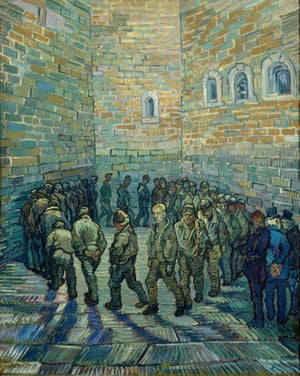


Photograph: © The Pushkin State Museum of Fine Arts, Moscow
It is true that the show also contains John Everett Millais’s powerfully dreich Chill October, which Van Gogh loved, and may have remembered when painting the dying light in his own Autumn Landscape at Dusk a whole decade later. And here is a Whistler Nocturne, though it is a considerable stretch to suggest that it had any effect whatsoever on Starry Night, with its golden emblems of hope ablaze in the midnight skies over the Rhône. Van Gogh’s supreme originality is all there in those stars and whorls and flakes of brilliant light. And Whistler was, in any case, American.
That Van Gogh learned from Gustave Doré (French) is not in doubt. Doré’s deathless etchings show London as a gaslit netherworld of poverty, smog and casual injustice, workers jammed in claustrophobic back-to-backs, addicts in opium dens, deprivation in doss houses. Van Gogh bought a complete set and even copied one print of prisoners forced to walk a cramped circle round and round Newgate yard. But his version is a painting, astoundingly bright, as if heaven were shining down upon these poor, benighted figures. It is the strangest paradox, a beautiful painting of the bleakest subject: a redemptive vision of hell.
Prisoners Exercising comes from the Pushkin Museum in Moscow. It is described by the curators as Van Gogh’s “only painting of London”, a curious claim, since he never saw the scene and made the work in Arles towards the end of his life. They are on firmer ground with those dark and knotted drawings of peasants from his early days back home in his father’s gloomy house, which do seem visually connected to the many English prints he saw in London in The Graphic magazine.
And you can just about believe the argument that Van Gogh’s portrait of his empty chair, stalwart yet humble, may have been inspired by Luke Fildes’s 1870 engraving of Dickens’s vacant study after the writer’s death. But that doesn’t begin to explain the marvellous expressiveness of Van Gogh’s portrait of his lonely possession, or the protectiveness millions of viewers feel towards that chair.

Van Gogh’s writings show admiration for lesser artists all through his life; his humility is deeply affecting. But it is no excuse for displaying so many of their works. And then the show goes the other way, with slews of British paintings influenced by Van Gogh, from Matthew Smith to Harold Gilman, Spencer Gore and Jacob Epstein. A whole gallery is devoted to their dahlias, chrysanthemums and lilies; any old flower, so long as it’s yellow and looks like a feeble tribute to The Sunflowers.
A Scotsman named Alexander Reid bought a painting directly from Van Gogh in 1887 – or at least he paid for the fruit depicted. A basket of apples surges like a life raft on an ocean of brushstrokes, flowing in waves and squalls up the canvas. Speed through the flower gallery – which feels like a form of crowd control, designed to deal with recurrent bottlenecks – and you will also encounter a spectacular yew tree, standing silver against a flaring yellow sky. And then a Wheatfield from the high summer of 1888, where the dabs and curlicues flow in wildly different directions and the hum of heat and light is so dynamic the picture is practically bursting.
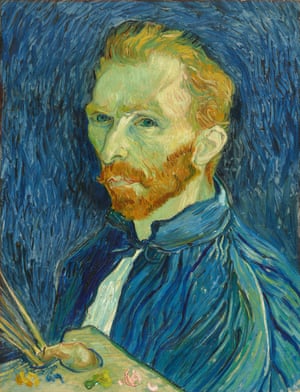


The sheer joy of it all is what strikes every time: every brushload laid upon the surface an act of exultation, every colour a kind of gratitude. Shivering harvest fields, delicate branches spreading like Hiroshige’s cherry blossoms, the trees outside the hospital at Saint-Rémy rippling to the cobalt skies like the flames of a summer fire, the asylum itself a stately golden palace. Even in a late self-portrait from the last summer of his life, when Van Gogh had been ill and was staying there, the painting is all exhilaration. The face is almost entirely green – “the green of a summer sky”, he called it – and the hair blazes up gold as a wind-flurried wheat field. You cannot look at it without being intensely aware of every stroke, the way the hand held the brush, pressing its freight of brilliant colour into the springy surface of the canvas over and again, this way and that – Van Gogh’s singular idiom, his spirit, at work.
It is no overstatement to speak of the aura of his paintings. And no disrespect to Whistler, Doré or any of the British artists in this show, to say that their contribution to Van Gogh’s brief but soaring flight is quite obviously negligible. It is still amazing to think how high and far Van Gogh flew, before killing himself at the age of 37. From the early chalk drawings in this show, tentative and ungainly, to the whirling skies and crackling trees and radiant stars, to the dizzying morphology of brush-marks that channel the sensational flow of his mind, eye and passion, it is barely a single, hurtling decade.
Joan Cornellà
A smiling decapitated head. An amputee wearing a shirt that says "free hugs". Guns at the end of selfie sticks and a whole bunch of dark fetus jokes. Joan Cornella's works paint the most WTF-scenarios imaginable in conflictingly cute comic-book aesthetics, and us sickos in Bangkok just can't seem to get enough. Which is why the Spanish artist is back with another solo exhibition in just a little over a year. Curated by Farmgroup, the latest showcase will feature works made specifically for the local audience and fan base, as well as venture into a new territory of sculptures. We interview Joan about his "Happy Endings" (exhibition), opening to the public at Woof Pack this Thursday, November 8, 2018.

Joan Cornellà (Photo: Courtesy of Supachai Ketkaroonkul)
Welcome back. What was your impression of your own exhibition here in Bangkok last time?
That was my first time in Thailand and the first exhibition here so I didn’t have any clue of how would it be. To my surprise, many people came and the attention received was huge. I could compare it to other places in Asia like Hong Kong or Shanghai—for some reason my work is better received here than in western countries.
So what brings you back to Bangkok? Tell us about the exhibition.
Recently I’ve been working on smaller formats, which is something that I used to do in the beginning, so it’s like going back to my roots. The exhibition will consist of more than 70 artworks—the biggest exhibition I have done so far—and I painted 40 of these works here in Bangkok so they’re kind of connected, indirectly, to the place. I didn't use to do this as I prefer my work to be globally understood, but I think it can be interesting for the exhibition. It has been also a challenge. Besides that, the themes or topics I worked with are basically the same ones: love and happiness.

Your art contains a lot of unexpected, dark and humorous twists that take your audiences by surprise. How are planning to surprise or even shock audiences even further?
I don’t have a plan or a method to work in that sense. It depends on many things. For the comic strips I need to work plot twists as everything falls to the narrative. However, for one panel pictures I have to work even harder because I have to sum it all up in one image. This is what I’ve been doing lately, and I’m having fun working without scripts for a while.
How long did it take to put together this exhibition?
I know the people of Farmgroup since last year, and they invited me to come to Hotel Art Fair on July, so it was easy to arrange an exhibition with them. It was just kind of a natural consequence.
How did you end up at this venue, Woof Pack and what do you think of it?
Farmgroup suggested the venue. They both worked together before and they know each other, so it’s great. The venue has different rooms, which means I can show more works than last year and people can also take more time to visit and view them.

In your observation, is your Thai fan base or the Thai art scene different than others?
I can’t tell. I guess I need to spend more time here to talk about that. The main differences I see are the same I see in Thai people in general. They like to take a lot of selfies at the exhibition, which is something that I rarely see in Europe. Most of my fan base are people in their twenties, so I don’t understand many of their reactions and behaviours because they are older than me. They could be my grandparents.
Your “cute, cartoonish” art actually reveal a lot of troubling social issues. What are some of the most troubling issues to you? Please elaborate.
I think there’s a big problem with political correctness, which I think most of times is a form of authority and self-repression that doesn’t allow us to express ourselves freely. It's the modern form of censorship. That’s why I think my work is related to these issues. I’d also like my work to overcome taboos and bigotry. For instance, some people think my work is racist and I would say the opposite. I would say they don’t know what irony is. I work with racist stereotypes in order to express moral thoughts. I want my work to be open to different interpretations because I don’t like mannequinism. I don’t like people telling others what’s wrong or right. I like to let people think by themselves and be more critical.

What else inspires your art?
I’ve always been interested in comedy. I like a lot of comedians like Louis CK, Monty Python, Bill Hicks, Sarah Silverman and George Carlin. The first time I watched The Monty Python Flying Circus, it blew my mind. British comedy is really great. Ricky Gervais, Peter Serafinowicz or Spike Milligan are some of my favorites. But obviously comics and graphic humour have also influenced me. Charles Addams, for instance, is a master of dark comedy.
The comics of Joan Cornellà Vázquez—better known by just his first two names—are immediately recognizable. Their bright colors and simple composition are cheerful and childlike by design, but they’re anything but innocent. Rather, they offer twisted glimpses into the ways of the world, holding a mirror up to the depraved nature of society and confronting issues of sex, religion, racism, and violence in graphic and grotesque ways.
Take, for instance, the cover of his new book, Sot, an image that partially doubles as the poster for the exhibition he’s currently touring across the world. It depicts a grinning man in a green suit holding a selfie stick. Instead of a camera at the end of it, however, there’s a gun. By Cornellà’s standards, it’s pretty tame, but it highlights the essence of what the thirty-six year-old Spaniard’s work is about and how it reflects society at large. Though he’s based in Barcelona, we caught up with Cornellà while he was setting up the New York leg of his exhibition to find out what lies beneath the surface and the shock factor of his work.
You’re travelling around the world with this exhibition, and as a result you’re sort of homeless right now.
Yeah, I’m homeless. I’m a nomad. We decided to do a load of exhibitions—I think there will be eight this year—and I decided to join the team [at Factotum Productions] and paint in every place as I show the works. So I to left my studio and apartment in Barcelona and do this for a while.
How are you finding life on the road?
It’s been just six months, so it’s fine for the moment. I guess if you’re a musician and you do that every day for five years it would be hard, but it’s not as if I’m working every day.
But you are painting as you go along.
Yes, I have no choice! I have to do that.
So how does traveling affect what you do? Do your ideas change depending on which place you happen to be in?
You know, if I get inspiration like this I’m not aware of it. I’m not doing this in a conscious way. And it goes so fast—maybe I spend one month in Hong Kong and another one in Bangkok. It’s not like I’m thinking about [being in those cities]. My work doesn’t work like that; I take more inspiration from the web. We’re living in a globalized world, and it’s not like I depend on real life. I like to spend time in different places for the different cultures and the different people you can meet, and I think that’s why I’m doing this. For my work, I’m not aware of any real inspiration.
I was asking because one of the first images I saw advertising this exhibition was the one where the woman is shot and then her face is painted black—and in America, police brutality of black people is a very big problem, so I wondered if you were inspired to make that one because you knew you were coming here.
I think a lot of my comics are related to Americans in some sense, but I’m not doing that on purpose. In Spain, we don’t have this amount of black people and this kind of conflict, but it still relates. And it was actually banned [by Facebook]. There were a lot of white people against this comic strip, and then a lot of black people saying, “This is the way it is.” So there was a definite conflict [in terms of response] between white people and black people, but I think that’s good because then you can see how people react—and I guess there’s a lot of racism here. I wasn’t that aware of it—especially in New York, I thought it was less that way, but the more I know about the place the more I’m surprised about it.
Do you see it, then, as your duty as an artist to make people aware of things like that? You’re not one who likes to explain what your art is about.
No, I never do that. But it’s there. At the beginning, I didn’t want my work to be political in an open way. For example, this comic strip we’re talking about, most people were pissed off and they called me racist and they were insulting me and this was maybe three years ago, and most of them were white or Asian and just trying to be politically correct. And in a way I think I’m doing this to fight against political correctness. But my work has a large relationship with violence and things like racism, topics that are so related to the United States. Where I’m from in Spain, we don’t have this kind of violence. Here, everybody talks about it and it’s in your face and they have this problem with guns, but for me, it’s just fiction. I’ve never seen a gun in my life! So I think it is super-related to this place, but because I watched a lot of movies and the United States is part of my culture.
There are people who will look at your work and say that it’s just violence for the sake of violence. Where do you draw the line between making a point and being gratuitous? People often seem to miss the meaning behind the shocking nature of your art.
It depends on the day. I can get pissed off with it, but you have to live with that. There are a lot of people and a lot of opinions and at the beginning I was reading all the comments [on Facebook], but now if I do this it’s a waste of time. I think my work, at some level, is kind of massive, and when that happens there will be some people there just in a superficial way. There are a lot of people who don’t understand. And it’s not like I’m saying “You have to understand this in some way” but they don’t give a fuck. They laugh and they find it hilarious, but because they find it silly. And I would like my work to have some deeper sense.
How have things changed for you since you’ve become more well-known?
One thing is that, at the beginning, there were a lot of people complaining and insulting me, but when something becomes massive, they accept it because a lot of people like it.
Does that push you to be more shocking with your work?
I think so. My work is made for Facebook most of the time, and they ban your stuff if it’s related to sex. But my comic strips that are related to sex aren’t my favorites. They’re fun, but they’re silly. It’s all about religion in the end, [though]. Facebook and the American mentality are religious, especially compared to other places. With the sexual comics, they act like priests most of the time, so I’m trained to fight Facebook.
Interview with Visual Artist Ellsworth Kelly at Art Basel
Yann Houri - Moments
Unit London
Born in 1990 in Paris, France. Yann Houri is a self-taught artist, currently living and working in Paris. Today, well known for his unique style of work, he combines different media and techniques, which allow him to explore his fascination of Man Kind’s daily choices and the repercussions of their consequent actions. Yann Houri has exhibited his work at Georges R. Brown Center in Texas, Suntec Singapore Center, Fondation Deutsch in Lausanne, San Mateo Center, Fort Mason Center in San Fransisco or Grand Palais in Paris.
The work of Yann Houri focuse on the complexity of the human subject and translates human emotions and time challenges into how we define ourselves in this mechanical and virtual age. The capture of each moment of life and each vibration is what human kind fails to admire in a contemporary lifestyle that pushes him to play constantly against time rather than cooperate with it in order to appreciate the present even before trying to plan the future and regret the past. His art interrogates our way to behave in a day to day life and put a strong emphasis upon the contemplation of the beauty of our own emotions and actions as present acts and vectors of energy. In an age where human creativity is data is comprised of replicable code, the works confront the viewer with a radical question of “What am I?”
Through his medium he explosively portrays his passion for visually recreating human emotion in a violently expressive and relentless form. He juggles between abstract and realism, his work is explosive with color but effortlessly secured together with minute detail. The effervescence of your first impressions fade away to reveal a deep palette of emotions offered to you through an intricate firework display of color and texture, apparent in all of his work. Brought to life are the feelings of resurrection, impalpable joy and an underlying sentiment of hope driving ones’ will to live. Human emotions are unarguably the inspiration behind his paintings and it is across facial expression accentuated by nuances and intensities between color, that Yann Houri brings not only the opposing and explosive powers of the feelings of others, but also of his own, out into the open.
Paricio • Picasso
Halcyon Gallery
Suited and booted, the artist Pedro Paricio looks like he’s come straight out of a scene from Reservoir Dogs. Born in 1982 in Tenerife in the Canary Islands, he is young, talented and now successful too. After working dozens of different jobs in pursuit of realising his dream of painting, he now lives off his art. And he lives well, at that.
He was signed up by the prestigious Halcyon Gallery in 2011 and it couldn’t have gone better for both parties. Diary of an Artist and Other Stories 2007-2012 was the artist’s second exhibition in this gallery. There were more than 50 exhibits with price tags ranging from £25,000, right up to £120,000. Almost all of them sold; some of them to important institutions.
Paricio’s artwork is first and foremost about contrasts of colour. Contrary to many other artists, his evolution has led him from the abstract towards a tendency for the figurative. He doesn’t play around with perception or with shadows, we find ourselves faced with a geometric and flat universe with constant nods to the 20th century painters he most admires. The artworks of his idols are sometimes the inspiration behind entire series, as was the case with Francis Bacon.
Before arriving in London, some Spanish galleries had already given him the opportunity to exhibit. The Ikara Gallery in Barcelona hosted his The Canary Paradise project in 2008, whilst Galería Muro in Valencia displayed the exhibition Un pintor. Otro. and Fe infinita were also shown in the Galería Fidel Balaguer in Barcelona. In addition, there was the significant exhibition in Seville’s magnificent Casino de la exposición, entitled The Theatre of Painting, where Juan Manuel Bonet praised his artwork and international career.
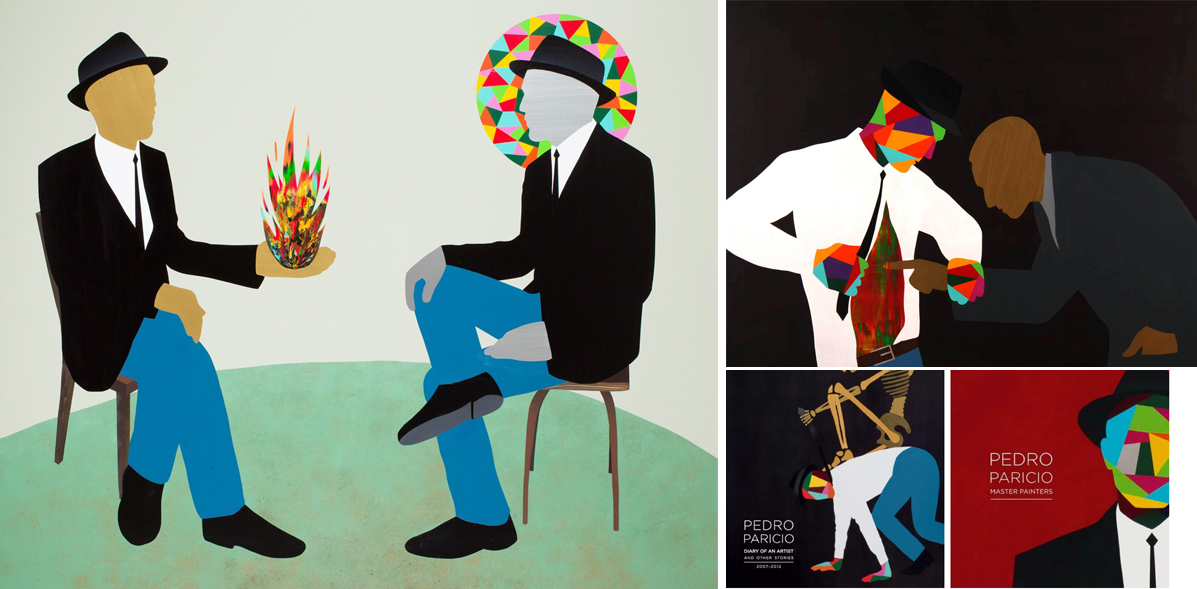
Pedro Paricio © Pedro Paricio / Halcyon Gallery
We put some questions to Pedro:
Every artist reveals a bit of himself in his artwork. In your case, self-portraits are incredibly important, especially in your most recent series. Is this some sort of internal search? Are self-portraits the most intimate creative exercise? Tell us something about that. Self-portraits allow me to reflect in two directions, I can speak about myself but at the same time about everyone else, because we are all different and yet we are all the same. You and I are we: two sides of the same coin. It’s also a question which touches on honesty and personal truth both of which are fundamental when it comes to art: without truth there is no work of art. My self-portrait is now my truth.
The first thing you see when you go on your website is a fantastic video which talks to us about colour, both in the world and in your artwork. Colour and great contrasts are clearly the building blocks of your artwork. Has it always been that way? Was it the landscapes of the Canary Islands that brought this on? The light of the Canary Islands has shaped who I am and the way I see the world, without a shadow of a doubt. This vision has then filtered into the different places where I’ve lived: Salamanca, Barcelona, London, Seville, Ibiza, etc. But it all goes back to the motherland, the Canary Islands, there’s no doubt about that. Tenerife is an incredible and, up to a point, surreal place, in its landscapes, the mixture of cultures and its island character. It’s no accident that the first international surrealist exhibition outside of France took place in Tenerife, with André Breton at the fore.
Your career took a leap forward when the Halcyon Gallery in London signed you up a few years ago. Do you think that the UK offered you opportunities where Spain didn’t? What do you think about the art market in both countries? Spain did offer me opportunities, my work was shown in many great galleries such as the Galería Muro in Valencia and the Galería Balaguer in Barcelona and significant media outlets such as La Vanguardia, El Mundo, Televisión Española and Tendencias del Mercado del Arte mentioned my work. I don’t think that you can compare different realities and anyway, I’m no expert in economics, what I can be sure of is that on a creative level, there is no country which Spain should feel jealous of, we are a land full of artists and this makes me very happy.
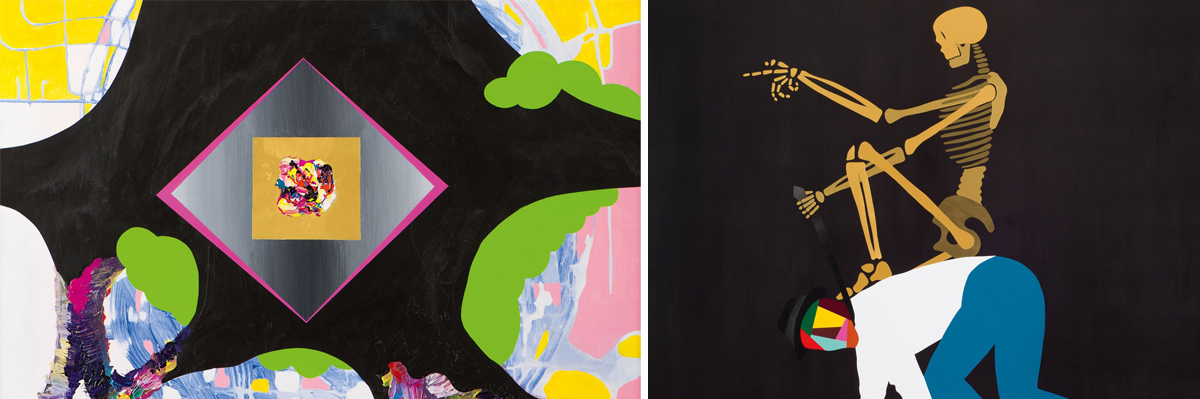
Pedro Paricio © Pedro Paricio / Halcyon Gallery
What is your relationship with the Halcyon Gallery like? Do you work with them exclusively? What steps did you take to secure representation from such a renowned international gallery? It’s great. It’s so gratifying that a gallery with three sites in London and another in Shanghai, which sells the works of masters such as Picasso and Matisse, would put such complete trust in a 29-year-old painter. Since I started working with them, I have been able to dedicate myself entirely to painting. The steps to success? Paint, paint, paint as if your life depended on it, because it works for me, because it’s what I am… because without painting I am nothing.
What are your dreams and plans for the future? Paint, study and live, which is one and the same thing.
When did you realise that you were an artist? Never, it’s not something that you realise, it’s something you are or you are not.
What do you think is your role in the current world of art? The same as Jack Nicholson’s in ‘One Flew Over the Cuckoo’s Nest’.
Who’s inspiring you to create at the moment? Wong Kar-wai, Fyodor Dstoyevsky and Tia Anica, la Piriñaca
What is your favourite food? A good bottle of red wine and anything that goes with it.
FOCUS: Agnes Martin
Lévy Gorvy London
Six Senses
What Are the Six Human Senses?
By Alex Silbajoris; Updated April 26, 2018The five senses traditionally ascribed to humans are vision, hearing, taste, smell and touch. A sixth "sense" could be proprioception, the perception of body position, which is important for balance and agility in movement. It could also include perception of stimuli from within the body, such as pain, hunger, or thirst.
The Limits of Vision
Human vision is the eyes' ability to sense electromagnetic radiation within a limited range of 380 to 780 nanometers. Through an effect called "flicker fusion," the eyes normally can't detect a flicker above about 60 hz in a light source, according to research done by NASA. Thus, a motion picture image appears to move smoothly, despite being a series of still images. Sensitivity varies across the retina; it's concentrated in the macula, which is the center of view. That's why you can see your hand held straight out to the side, but you probably don't have enough acuity to count the fingers.
Human Hearing Is Tuned
The normal range of human hearing is from 20 Hz to 20,000 Hz. The ear funnels sound waves, actually the vibration of air molecules, to the eardrum. This then also vibrates, setting into motion a chain of small bones, called ossicles, which stimulate the cochlea, a fluid-filled organ, which then stimulates nerves. The outer ear, called the pinna, faces forward to favor gathering sound from ahead, above and below. It includes complex ridges that selectively funnel frequencies into the ear canal. This helps you detect the direction of incoming sound.
Taste and Smell Are Linked
Taste (gustation) and smell (olfaction) are related senses. Unlike vision or hearing, there's no set range of sensitivity. The tongue can sense flavors that are sweet, sour, salty, bitter and savory. Part of the perception of flavors comes from aromas reaching olfactory nerve cells in the nostrils. PubMed Health states that these senses are connected to the involuntary nerve system, so they can trigger bodily reactions from vomiting to salivation.
Touch is Electric
The sense of touch is part of the somatosensory system, which also includes senses of pain, tickling and itching, along with awareness of body position and movement, called proprioception. Touch sensations can be sorted into sub-categories, such as sharp pain, aching pain, and tactile stimulations such as pressure and vibration. The sensory receptors in the skin are called Merkel cells, and they reside at the base of the epidermis and around hair follicles. Researchers at Columbia University report that their function is similar to the nerve cells in the cochlea, turning sensations like vibrations or texture into electrical signals.
Other Ways of Sensing
The number of described senses beyond the traditional five varies by source. Harvard Medical School says the number varies even among researchers within their institution. The list can include temporal perception, the sense of the passage of time, and interoception, sensations coming from within organs. Equilibrioception is the sense of balance, and thermoception is the ability to feel hot and cold.
Marion Ackermann
More than Human: an Interview with Tomás Saraceno
On the occasion of our Focus on ARCOmadrid we interviewed artist Tomas Saraceno.
Tomás Saraceno was born in 1973 in Tucumán, Argentina and he lives and works in Berlin. Tomás Saraceno’s oeuvre is an ongoing research: his floating sculptures, community projects and interactive installations propose and explore new, sustainable ways of inhabiting and sensing the environment.
In 2015, Saraceno achieved the world record for the first and longest certified fully-solar manned flight. During the past decade, he has initiated collaborations with renowned scientific institutions, including the Massachusetts Institute of Technology, Max Planck Institute, the Nanyang Technological University of Singapore, and the Natural History Museum London. He was the first person to scan, reconstruct and reimagine spiders’ weaved spatial habitats, and possesses the only three-dimensional spider web collection to existence.
Carla Ingrasciotta: Your oeuvre is a mix of the worlds of architecture, natural sciences, astrophysics and engineering. How did you end into art? Could you tell us a bit about your background?
Tomás Saraceno: In my practice I enjoy merging things coming from different realities and I engage with them to enlarge the community linked to contemporary art. I try to explore unknown territories to find possible new ways of understanding our futures.
C.I.: “Cloud Cities” is one of your biggest project and it is strongly related to the sustainable development of the human living environment. Could you tell us about the process of creation of this artwork and about your practice in general?
T.S.: In my artwork I always take into consideration not only the human environment but also the surrounding environments which are related to us. It’s a matter of being aware of this strict relationship: I think that there is a specific interaction between human and nature and we should start to be aware about this relationship and explore how we interact with different realities, how we influence each other in our relation with the sun, the earth, the cosmos, the spiders, the heat, the cosmic dust. We need to enlarge our perspective of human and get into “more than human” worlds. We need to discover the links among these realties, observe, compose and build.
C.I.: Could you explain how did you create the artwork?
T.S.: The artwork we are going to present during ARCO will be the perfect example of how we work and perform. We are showcasing the process of creation of spider webs, we will give space to spiders to work. We will show that and make people look at the spider webs. We have been working on this project for years. We move a hybrid spider web into some sort of fog, a cloud of cosmic dust, to discover and see how this structure is made.
In this specific project for ARCO, we will showcase the result of a collaboration between two different species, investigating the factors that inform the way of building these incredible structures, such as dust, air and other natural elements.
C.I.: This year, ARCO Madrid is giving to the art scene of Argentina a special platform and you’ve been selected as one of the representative artists. Could you tell us about your participation to the fair and the project you will be presenting?
T.S.: Among others, the project also deals with “Cloud Cities”, through which we are exploring the idea of floating in the space, traveling to different places. We are trying to enlarge the understanding of the world from different point of view including perspectives coming from biology, engineering, astrophysics … It’s really important to understand the world from different points of view: from archeology, philosophy, to informatics and technology (see my collaboration with MIT). This is the way to reimagine how many links connect each other.
C.I.: And what about your engagement within the Argentinian art scene?
T.S.: We are having a new exhibition at the Museo de Arte Moderno de Buenos Aires in Argentina and I’m very keen on going back and collaborate with different artists, and with the people we have been working together. I’m curious and happy to be back home and see how we could reinforce certain aspects within the Argentinian contemporary art scene.
C.I.: How is it like working with such a big team as yours? Could you tell us about your life in the studio? How is your typical daily routine?
T.S.: We all have different backgrounds and our stories overlap one another. It’s really nice to see how differently we see and perceive each other’s pieces. We often merge our works and sometimes incredible artworks come up with unexpected and surprising results. Some of these objects are kind of magical…sometimes we just let things happen inside our community
.C.I.: Do you feel more like an artist, a dreamer or a scientific researcher? Do you think that these roles can coexist?
T.S.: Yes, I think so and this happens many times. Art has the power to extend our way of feeling the world. You never know what is really an artwork. To me, anything that evokes something we are engaged to, can be considered an artwork. There are many possibilities to enter a conversation and freely choose what is art for them. Anybody can be an artist, anyone who is part of an artistic discourse. That’s why we should redefine what art is: it’s not just a matter of curators, museums, galleries …is more a matter of diversity.
C.I.: Could you tell us about the new themes you are going to explore in the future?
T.S.: The project I will be presenting at MAMBA is particularly fascinating: we are investigating on the cosmic dust, the multitude of particles that compose the planet Earth.We will give this element a voice, we will play music according to its movement within the exhibition space, we will investigate on the visitors’ experience of breathing it, touching and feeling it.The movement of the particles will produce different sounds depending on the visitors interaction with them: sometimes it will come up as a cacophony, sometimes as a jam session. It’s interesting to see the various results produced. Visitors will become composers, part of the installations itself. Each user will create a complex relationship with this artwork. This is a compassionate way of engaging the artwork and it will be a new way of understanding and be aware of how much we are part of an ecosystem. And since I’m an artist, I’m trying to do artistic practice in an ecological way, but considering not only environmental, but also social and mental ecologies.
 Tomás Saraceno, The Endless Series, 2006. The photographs were taken at Salar de Uyuni, Bolivia with the support of Barbican Art Gallery. Courtesy the artist; Tanya Bonakdar Gallery, New York; Andersen's Contemporary, Copenhagen; Pinksummer contemporary art, Genoa; Esther Schipper, Berlin. © Photography by Tomás Saraceno, 2006
 Tomás Saraceno Aerocene, launches in White Sands (NM, United States), 2015. Courtesy the artist; Pinksummer contemporary art, Genoa; Tanya Bonakdar, New York; Andersen's Contemporary, Copenhagen; Esther Schipper, Berlin. © Photography by Tomás Saraceno, 2015
 Tomás Saraceno Aerocene, 2015 During the oceanographic expedition to Solomon Islands upon the invitation of TBA21 Academy. © Photography by Tomás Saraceno and TBA21, 2015
 Tomás Saraceno 32SW/Stay green/Flying Garden/Air-Port-City, 2007 Installation view, Lyon Biennale. Courtesy the artist; Tanya Bonakdar Gallery, New York; Andersen's Contemporary, Copenhagen; Pinksummer contemporary art, Genoa; Esther Schipper, Berlin. © Photography by Studio Tomás Saraceno, 2007
 Tomás Saraceno, Aerocene 10.4 & 15.3, 2015. Installation view, Grand Palais, Paris. Courtesy the artist; Tanya Bonakdar Gallery, New York; Andersen's Contemporary, Copenhagen; Pinksummer contemporary art, Genoa; Esther Schipper, Berlin. © Photography by Tomás Saraceno, 2015
Tomás Saraceno is the go-to artist that allows you to appreciate his works through my own feelings. Mostly simulated, I have never been to any one of his exhibition, but if there is one in London, I will go definitely. His pieces are all simple, they have been designed. Inspired from clouds or natural configurations. It is said that he has been doing architectural art scene for over 10 years, they are large-scale of installations.
Allan Gardner
Weaponised Silence: An Experience With Lawrence Abu Hamdan’s ‘Saydnaya, Allan Gardner
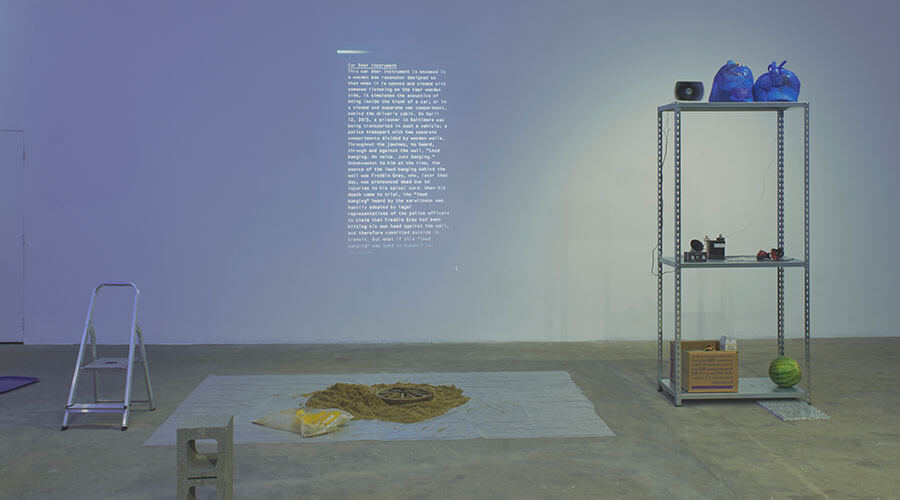
I want to begin with a caveat – I have been to Lawrence Abu Hamdan’s Earwitness Theatre at Chisenhale Gallery once. I attended the opening, an incredibly busy opening, and this was the context in which I experienced the work. For this reason, I’m going to be focusing almost entirely on Saydnaya (the missing 19db) (2017), the reason for this being that this is the only piece with which I really had an experience on that opening night. I suppose it might be worth highlighting that an opening is rarely the best time to experience a work and nearly a month after the fact is rarely the best time to write about a work but in this context, I think it speaks to the quality of the piece. Lawrence Abu Hamdan and Forensics Architecture have been receiving a great deal of press, a great deal of conversations surrounding whether it really is art at all and exactly where the line is between political research -also with a heavy reliance on the most advanced technologies- and artistic practice, [1]. This piece of writing is my assertion that, within Earwitness Theatre, Saydnaya is irrevocably a piece of art, an arresting piece of art. The kind of artwork that burrows into your mind and has you talking about it consistently for weeks.
Entering the main room at Chisenhale, there is a collection of objects to the right side and a projection on the far right wall. On the left of the room, there is what appears to be a sort of hut, with a gallery assistant escorting viewers in and out. I stumbled briefly past a popcorn machine, soda bottles and assorted detritus before approaching the hut and being lead in, just as the audio piece began to play.
I sit on the floor with around fifteen other people, two speakers pointed at us. There’s something about having these so visible, especially with their green LEDs as the only light source within the room, that feels authoritarian. We are on one side, sitting, they are above us and freely omitting sound as we observe polite silence. The act of sitting on the floor presided over by speakers and surrounded by strangers, re-contextualises the space in a powerful way. As the piece begins to play, I already feel very aware of my body. The sound of my fingernails against the bottle in my hand seems loud and intrusive and no seating position really feels natural.
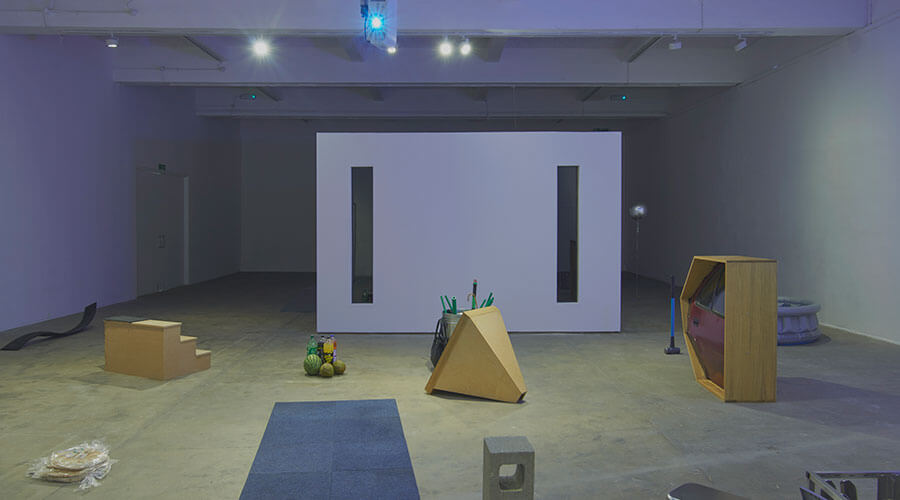
As Saydnaya plays, we hear stories about the silent prison. With verbal communication punished by beatings, sound is weaponised, turned into an authoritarian tool to manipulate and dehumanise detainees. We hear of guards taking off their shoes so as to catch inmates talking, finding excuses to inflict pain, to enact the beatings that all too often slide into state-supported murders. Solidarity is explored, stories of sick prisoners coughing (also forbidden) and not being able to sustain the beatings in their weakened state lead to healthier comrades taking their place in an act of empathy. As the audio plays, I become more conscious of the social event going on just meters away. I don’t feel like part of it, the sound of the people laughing, networking, leaks into the space. I want to say that it undermines the experience but maybe that isn’t correct, it inflicts itself upon it, minimising the plight examined therein.
Many of lucky enough to survive their stay at Saydnaya leave with their hearing severely affected from the periods of strain. Test tones play at different volumes, reflecting the sounds that ex-prisoners remember the guards’ footsteps at, both before and during the Syrian Civil War. As I strain to hear the lowest tones, I become aware of my own tinnitus. I become aware of the pain in the tops of my eardrums and the dissonance that comes from trying to make sense of a near-silence. Disregarding the leaking noise of the crowd, focusing on Hamdan’s work, focusing on the stories and the decreasing volume, the discordance of this near-silence ringing in unison with the din of what has begun to sound like a party.
With Saydnaya, Hamdan brings the conversation around freedom and the removal of freedom on a human level into a place where maybe they may not always be found. Authority has found opposition within his work, conceptually as well as material. His unique and powerful use of audio as media is what makes this work so effective. In Saydnaya, Hamdan makes me acutely aware of sound. Sound is used as a vehicle for empathy, for education. The piece makes me aware of the functionality of sound in a way that I am normally not. It’s in this that I am comfortable in describing what he makes as, not only art but progressive and exciting art. I left the exhibition almost immediately, feeling it impossible to return to the crowd.
Jean-Claude Ellena
Jean-Claude Ellena, 65, was born in Grasse, in Provence, the son of a perfumer. In 2004, he became in-house perfumer for Hermès, where perfume sales have since more than doubled. The company set up a laboratory for Ellena near Grasse in a late 1960s architect's villa surrounded by black pines and blessed with a view of the Côte d'Azur through full-length windows. Ellena's new memoir is entitled: "The Diary of a Nose: A Year in the Life of a Parfumeur."
SPIEGEL: Monsieur Ellena, you are considered the best "nose" in the world. Does it seem strange to you that perfumers are called "noses," whereas no one would think of calling a conductor an "ear"?
Ellena: Yes, it's funny, particularly in my case, because it doesn't actually match what I do. As an organ, my nose simply performs a control function. I smell with my brain. It stores every scent and knows how to combine them. The perfumes I create originate in my head.
SPIEGEL: Is that typical?
Ellena: There are perfumers who take a more intuitive approach than I do. My father, for example, and my daughter, as well. Come on! Let's take a break and go over to my lab and I'll show you something.
SPIEGEL: A break? We just got started.
Ellena: It doesn't matter. Come on, come on.
SPIEGEL: What are you planning? Why are you opening all these bottles?
Ellena: We're going to play a little. Take this test strip; I've dabbed it with orange oil. Wait a moment! I'm soaking the next one in a chemical substance called Rhubofix. And, now, lay both test strips next to one another -- et voilà. What do you smell?
SPIEGEL: Grapefruit.
Ellena: Ah, correct. And now -- one moment please -- take this coconut scent and now this strip with mint scent and, again, lay them on top of each other. Do you smell it? Fig. And, now, choose a scent.
SPIEGEL: Oh dear. Very well, how about passion fruit?
Ellena: I'm sorry, that's not possible. I don't have the ingredients here. I've reduced the number of ingredients I work with, and now I have only 200. Most perfumers have 1,000.
SPIEGEL: You've limited yourself by choice?
Ellena: Yes, it's a matter of control. Excess scares me. And I want to force myself to create simple scents. The first perfume I made, when I was 28, called "First" …
SPIEGEL: … which was a great success …
Ellena: … well, it's a bit overloaded, with 160 ingredients. Far too many. My scent Terre d'Hermès, from 2006, has just 30 ingredients. That's good. I want to be simple, like a Japanese haiku. It's actually the most difficult thing, being simple.
SPIEGEL: Here in your laboratory, you have as many chemical scents as natural ones. Most people think a good perfume needs to be entirely natural.
Ellena: Yes, unfortunately that's true. It's a matter of names. We associate images with natural scents. When we hear "patchouli," we think of a flowering plant from India; when we hear "vetiver," we think of grass. But when you give things chemical names, they lose their poetry, and people become afraid. Chemistry is seen as a bad thing. But chemistry isn't a bad thing for us as perfumers. In fact, the entire industry first came into being because of the enormous developments in chemistry at the end of the century before last. Everything we call perfume today is always a combination of natural and chemical ingredients.
SPIEGEL: Why is the perfume industry dominated by France?
Ellena: It's because of Louis XIV, the Sun King, who very much supported leather, cloth and perfume production. Thank you, Roi Soleil! And since we've been working with perfumes for so long in France, we're good at what we do. It's a matter of experience. These days, though, the industry doesn't allow young people the time they need to develop. After all, we learn from our mistakes.
SPIEGEL: You've just written a book in which you emphasize how closely you are involved with the arts. Do you wish to liberate the perfumer's work from the sphere of capital?
Ellena: Developing perfumes is a creative process. What I do is different from what a craftsperson does. When craftspeople begin their work, they have an idea of what they will end up with, whereas I haven't the slightest idea. I'm also not ashamed of the fact that perfume is a luxury product and that people earn money from it. Please! Those are jobs being created.
SPIEGEL: Talking about perfume is more difficult than talking about art.
Ellena: Do you think so? How would you describe a painting by an unknown artist? "Oh, it's very blue." Or: "It's a lovely, dark red." Then you get no further than that. We help ourselves out by using the artist's name, and that makes it easier to talk about: "Ah, okay, it's a van Gogh." When it comes to perfume, the industry has helped us out with a similar trick. The moment someone says, "It's Chanel No. 5," then everyone has an idea of what it is.
SPIEGEL: You wouldn't have written a book about the daily life of a perfumer if everyone already knew about it. It's a profession we don't talk about very much.
Ellena: Thirty years ago, I may well have been the first to talk to journalists about perfume. At that point, it was fashion magazines, and they wanted three or four sentences. Now, though, people recognize that this is an important line of industry. Far more revenue is made with perfume than with CDs or DVDs, and we talk about CDs constantly. When it comes to talking about scents, yes, we're still in the early stages.
SPIEGEL: The words we choose are telling: In German, you say that someone "composes" a perfume. Do you see yourself as a composer?
Ellena: What I do is far removed from what a composer does. After all, there are only 12 different notes that provide the foundation in music. Okay, yes, you can vary those notes in an endless number of ways, but you have to consider that my foundation consists of 200 scents. And, even more importantly, the equivalent of musical harmony is created in a very different way in perfumes. In music, for example, there is the triad: C-E-G. I can play those three notes simultaneously on the piano and then I have harmony. With perfumes, though, I can mix two ingredients, as we just did, but they don't actually meld. Each scent evaporates in a different way and, ultimately, the individual scents continue to exist in parallel. Things can truly blend in music, though not in perfume. That creates a challenge, but also an opportunity.
SPIEGEL: Your scents give the impression that this is exactly what you're trying to demonstrate. They are not just lovely; you always mix a small element of confusion in them, something bitter or even slightly foul. Beauty, as some poets claim, only becomes apparent when it very nearly crosses over into something ugly. Do you share this view?
Ellena: Oh, if we start talking about beauty, we'll be sitting here together for a few more days. If you see it that way, that's okay. All I can say is that I've grappled with the question of what this means, what I've just described to you: that scents don't actually mix but, rather, exist in parallel. I'm interested in Japan, Zen Buddhism, Taoism. The idea of the Tao is that it is complete, that everything belongs together, although the Tao is made up of components that can't actually be brought together. This idea confirms my experiences with perfume.
SPIEGEL: But what distinguishes a good perfume from a bad one? The quality of the basic ingredients?
Ellena: Not necessarily. Sometimes I achieve a better result with ingredients of mediocre quality rather than with exquisite ones. The important thing to me is that a scent corresponds to my idea of it. I'll give you an example: I wanted to use a lavender scent for a perfume and combine it with licorice. So I went to a lavender field nearby -- good quality. But I have my own idea of lavender, and this lavender from the field had elements that deviated from my idea. So I went to a laboratory and told the chemist there: "There are these small molecules that don't sit well with me." Three hundred separate molecules make up the scent of lavender. The chemist broke the lavender down into its component molecules and removed the ones I didn't want. Then I liked the scent.
SPIEGEL: A perfume only works if a large number of people like it. How do you determine what is currently in demand?
Ellena: I don't want to know. That's the wrong approach. A perfume is right if it's right for me. When I was young, I was very interested in the market and wanted to do everything right. I wanted to serve this and that interest. And what came out of that? As I said, an overloaded scent.
SPIEGEL: You were born here in Grasse, in Provence, where there are still dozens of perfume companies. Is this the only place once can be a good perfumer?
Ellena: Interesting scents exist everywhere in the world. I live here because my family is here. When Hermès hired me, I told them I didn't want to go to their headquarters in Paris. I need distance. Anyone doing creative work needs that. And you work more when you're alone. I start every day at 8:30 a.m. Perfume is my passion, but passion without discipline won't get you anywhere.
SPIEGEL: At most companies, marketing people decide which perfumes will be released on the market, but you insisted on being able to decide that yourself. In other words, if it's a flop, it's your flop.
Ellena: Marketing people should concern themselves with how to sell things. What makes a good perfume is something that I know better. But, it's true, working on any new scent involves a certain element of fear -- the fear of having no idea.
SPIEGEL: Your Terre d'Hermès was considered a great success. Your Un Jardin après la Mousson, on the other hand, was considered a flop. Do you have an explanation?
Ellena: Perhaps it was the name. The word "terre," or "earth," is something most people understand, but not the word "mousson," or monsoon. I was determined to have this name, "a garden after the monsoon." But I've realized that most people in Europe either don't know what a monsoon is, or they think that this sort of heavy rain is a catastrophe because they've always heard about people dying from them. In India, though, a monsoon is associated with good fortune. People can irrigate their rice fields, and life begins anew. Do you think that perhaps I should have chosen "rain" instead of "monsoon"?
SPIEGEL: Looking out the big windows of your beautiful house here today, everything is overcast. How should a perfume smell that's meant to recall a rainy day?
Ellena: Intense. A scent is chemical information transformed into an electric signal. Our sense of smell is better when it's warm and humid, which is why we perceive smells more strongly in the tropics.
SPIEGEL: Your scent Un Jardin après la Mousson seems to tell an entire story. And you even say it that way, that you "write" perfumes. How does that work?
Ellena: Let's take Terre d'Hermès as an example. Once a year, all of Hermès' manufacturers receive a motto from the company's headquarters. This time it was "terre." One thing that might have called to my mind is ocher-colored earth. We associate colors with scents; for example, the color blue is fresh, like water. But that doesn't tell a story yet. I went to Ireland -- my wife is Irish -- and I sat outside and did watercolors. A landscape changes when people take possession of it. When I see a meadow that has a stick stuck in it, I know a person has been there. So I wanted to tell the story of humanity and earth. What scent occurred to me for a vertical stick of wood? Cedar. And for grass with roots reaching deep into the earth? Vetiver. So I progressed that way, the same way you might write a story, creating new associations.
SPIEGEL: That sounds poetic. But, in reality, what a person likes in a perfume is a simple thing.
Ellena: Yes, but for me as a perfumer, it's interesting to know how I achieve a good scent. People like to eat sweets and, as a manufacturer, I can quickly achieve an effect by using a lot of sugar. But, by doing so, I ruin the flavor. It's the same with overly sweet scents.
SPIEGEL: Taste and smell are certainly very close. Is there a connection between what you like to smell and what you like to eat?
Ellena: I like savoury foods more than sweet ones. But I need to be careful with what I eat because it affects my sense of smell -- no garlic, nothing spicy, no onions. I like eating garlic, but only on Sundays.
SPIEGEL: What smells do you not like?
Ellena: A perfumer must maintain distance from all scents, the good ones, too. We like the familiar, the smells of our family -- that also has to do with the fact that we eat the same things. So we can't evaluate the smells from our direct environment very well. I'll tell you a story. When I was young, I was mentored by Edmond Roudnitska, a great perfumer who also lived here. One day, I rang his doorbell, but he sent me away, saying: "You stink of laundry detergent." The next day, I came back wearing the same thing, and this time he let me in. He showed me his dog, a Chow Chow, and told me he washed the dog every day with shampoo and water so it wouldn't smell. Now, I can't tell you that the dog didn't smell. But, then again, it wasn't my dog.
SPIEGEL: Did Roudnitska influence you more than your father, who was also a perfumer?
Ellena: My father rarely talked about his work, and my mother wasn't interested in it. Of course, she was interested in the money he earned from it. But my father sniffed everything -- the book he was reading or the food he ate. My mother found that unseemly. Perhaps I became a perfumer to find out what it was that fascinated my father so much.
SPIEGEL: Your father was the one who saw to it that you became a perfumer.
Ellena: Well, I was not a very good student, and my mother was concerned, but my father wasn't. He got me a job in the perfume industry in Grasse when I was 17.
SPIEGEL: The perfumer profession has changed, partly due to EU standards that have banned various ingredients.
Ellena: I take that as a challenge to think in a different way. Picasso once said: "If I don't have green, I'll use red." Voilà tout. That's all.
Cause by now owing to our technology, everything becomes possible, going back to original can be a good way of creating excessed all expectation. I just follow a New York-based artist name KangHee Kim, her photos are marvellous. She developed herself with her own style, one which sees sunsets, blue skies and palm trees superimposed to peek through the windows, or over the shoulders of passers-by, in the most mundane of scenes. “dreamy and fresh”, her photographs are connected with Mother Nature in modern world. Finding things beyond expectation with clouds, moon, trees, even otter. Ellena says"But when you give things chemical names, they lose their poetry, and people become afraid." I think I can link Anicka Yi attitude with what he says together. Maybe create a scent with chemical name. I quite enjoy in how he metaphor music with scent and art. He has a lot of good response towards the questions, Jean-Claude Ellena doesn't composing fragrance with top notes, middle notes, and base notes. He creates the feelings and the ideas he wants to convey.